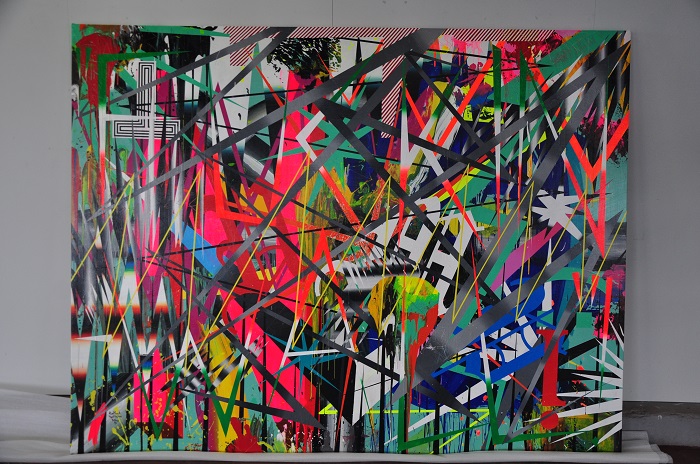
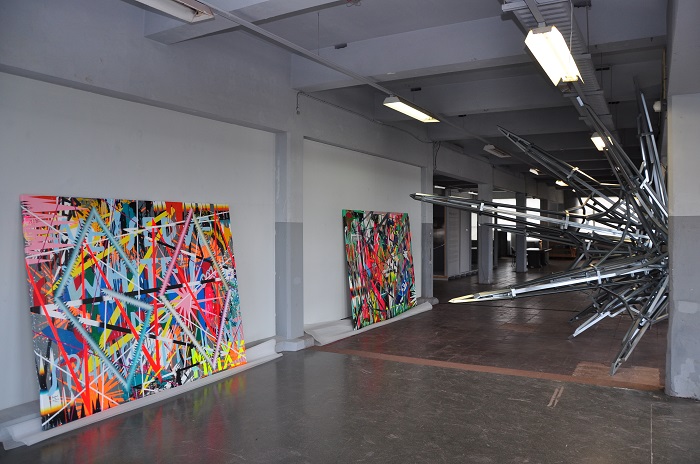
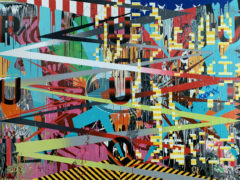
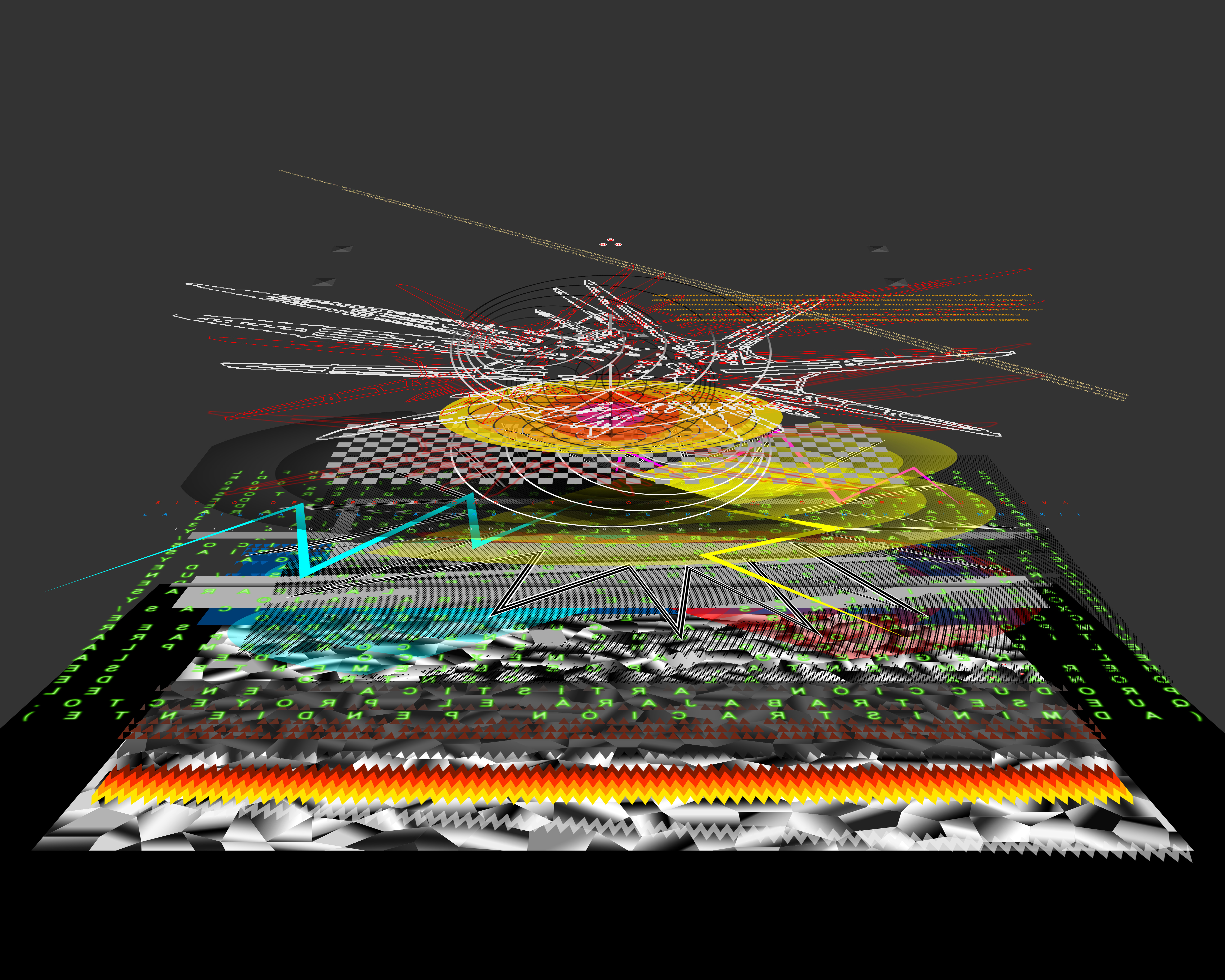
acrílico sobre canvas, 320 x 210 cm, D Ruanova 2021
________________________________________
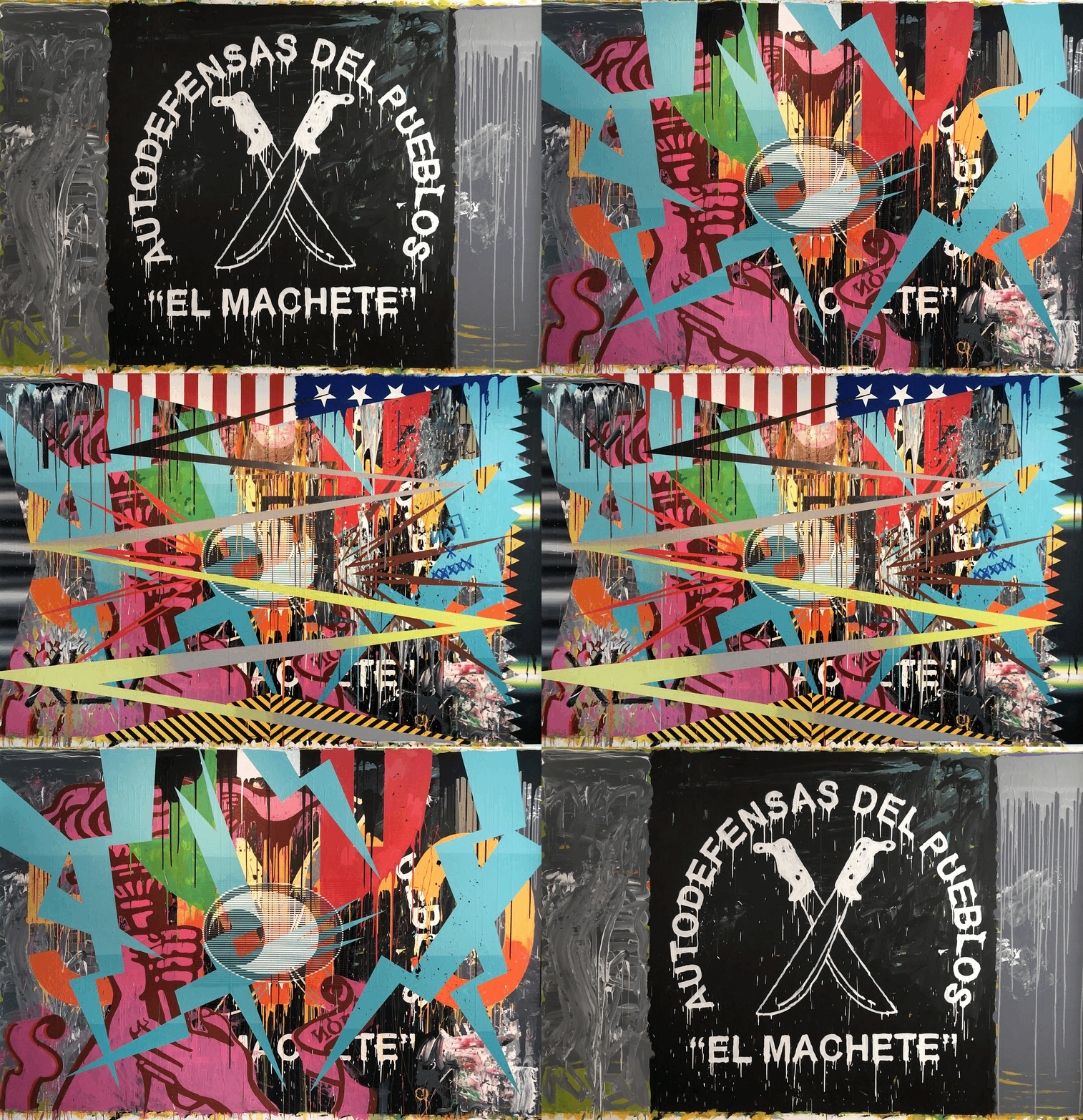
Todas mis pinturas empiezan con una idea como base física y conceptual, la primera etapa de un camino con destinos desconocidos. A unos pasos se deja de ver el comienzo y solo se ve el camino, andado y por andar. Trato de retratar la heráldica del hoy mexicano, los símbolos que usamos para darle forma al grito político…. van treinta años desde que el EZLN interrumpió en el sueño popular nacional, y se convirtió en un sinfín de cosas… Esta pintura, esta idea, este documento, empieza con una mutación de aquellos sueños de liberación social convertidos en una pesadilla de atrincherados del narco estado. Quedará enterrada durante el proceso de construcción de imagen…
English trans.
All my paintings begin with an idea as a physical and conceptual base, the first stage of a journey with unknown destinations. A few steps into it you can no longer see the beginning and you can only see the path walked and to walk. I try to portray the heraldry of today’s Mexico, the symbols that we use to shape the political outcry…. Thirty years have passed since the EZLN interrupted the popular national dream, and turned into so many things… This painting, this idea, this document begins with a mutation of those dreams of social liberation turned into a nightmare of entrenched confrontation with the cartels. It will be buried during the image construction process …
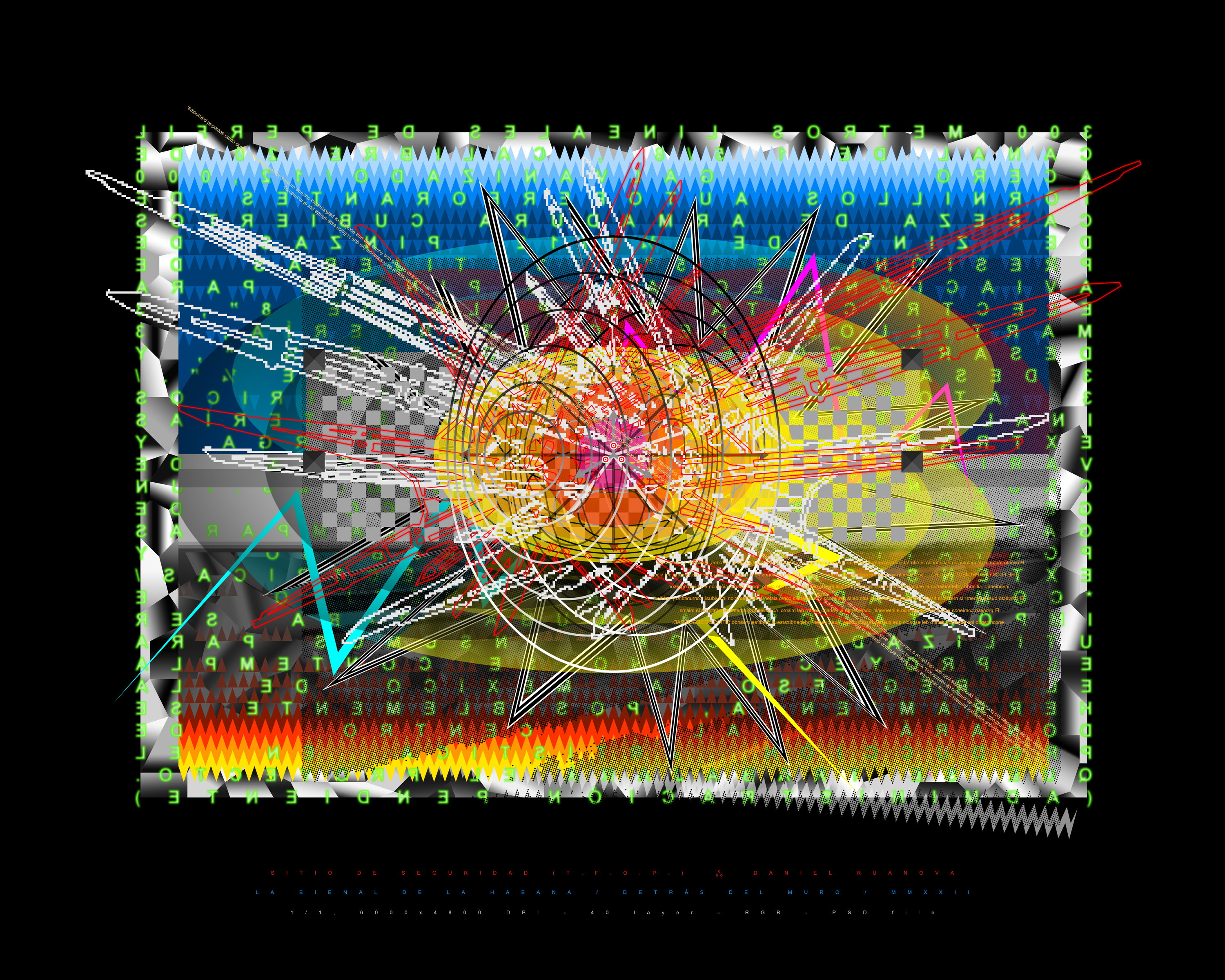
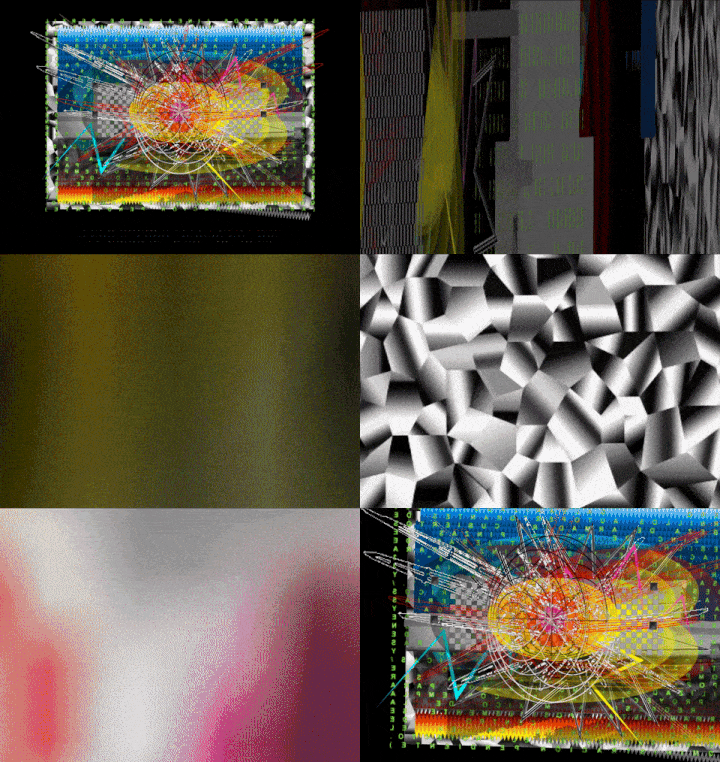
image: preview of original PSD file. courtesy of the artist
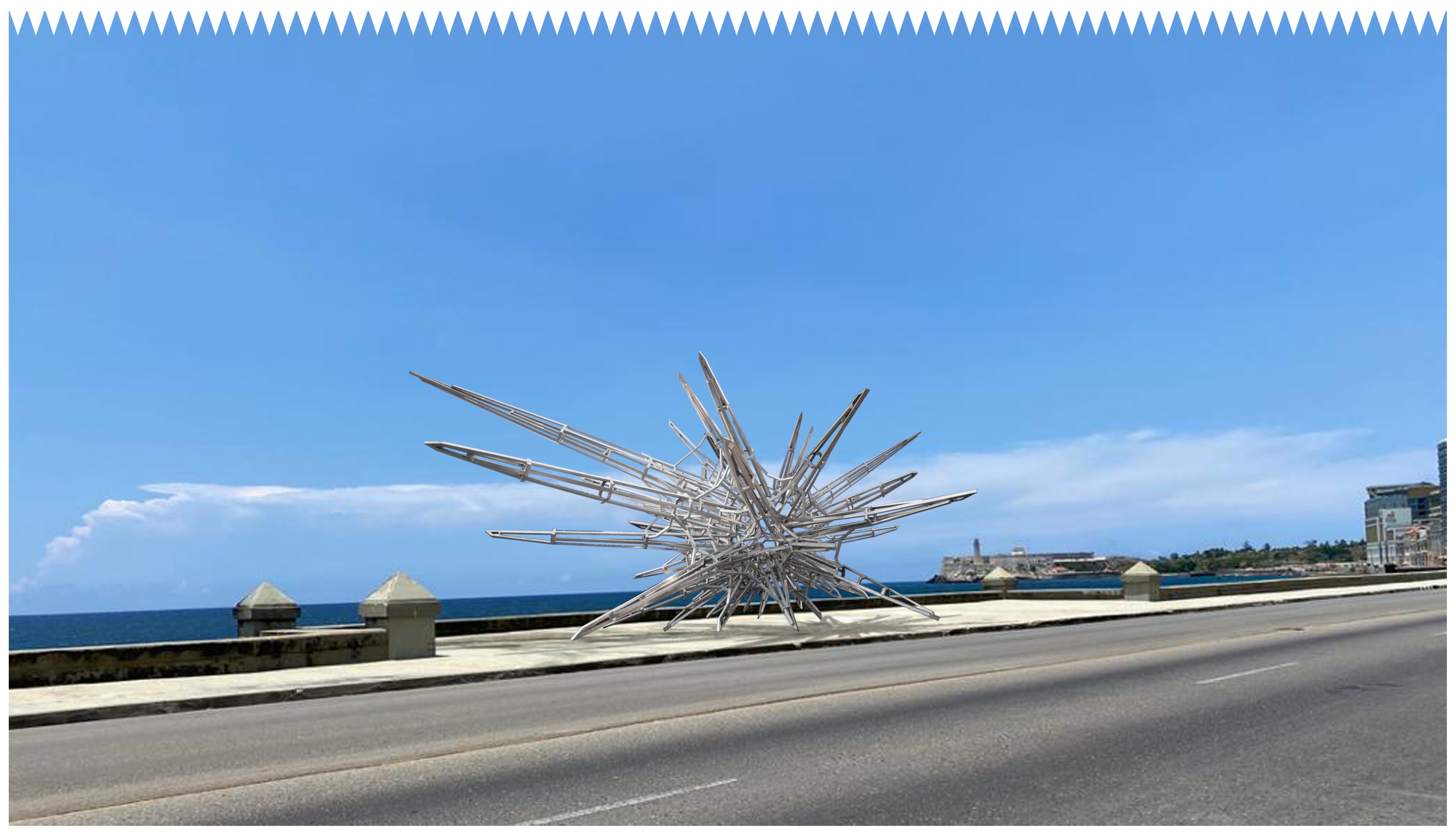
As the only spatial study and conceptual blueprint for the imminent onsite installation of Daniel Ruanova`s large format physical sculpture in Cuba for La Bienal de la Habana 2022. This NFT project is made to enhance the comprehension of space, time and intention in regards to why install an idea such as this one, in a place such as El Malecon de La Habana, the Havana pier.
image: photo render of previous edition of physical sculpture installed on the Havana pier. courtesy of the artist
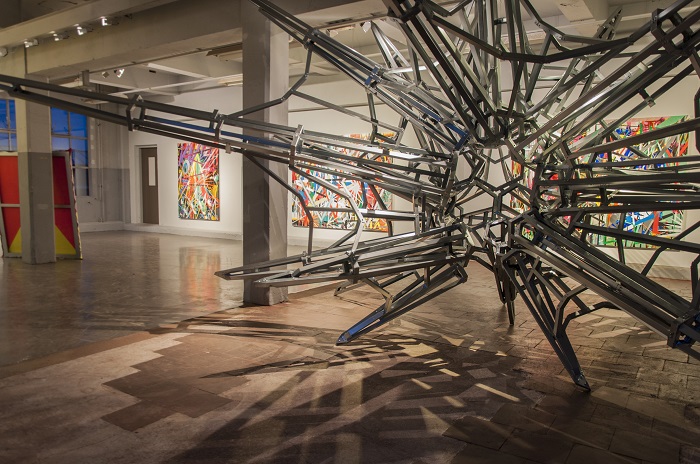
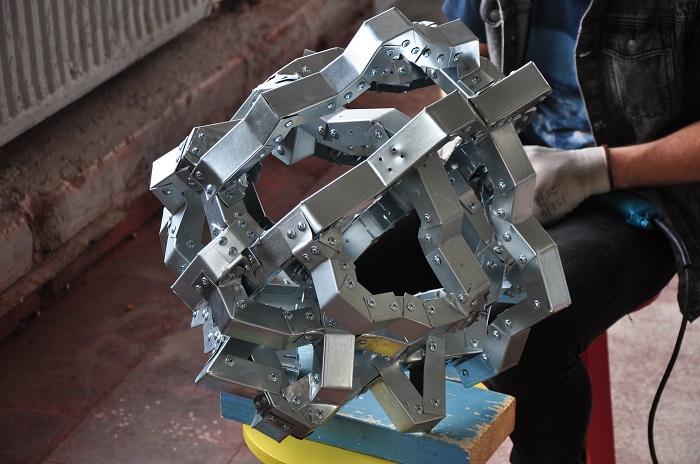
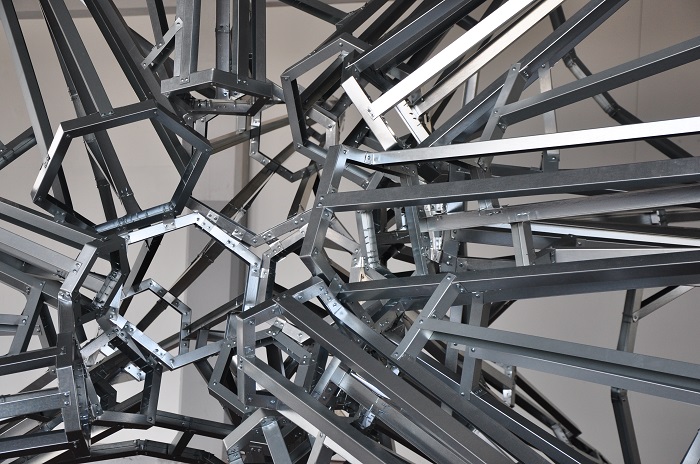
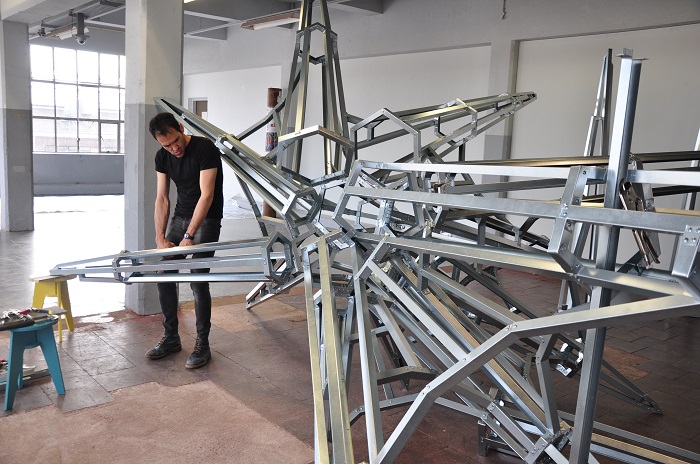
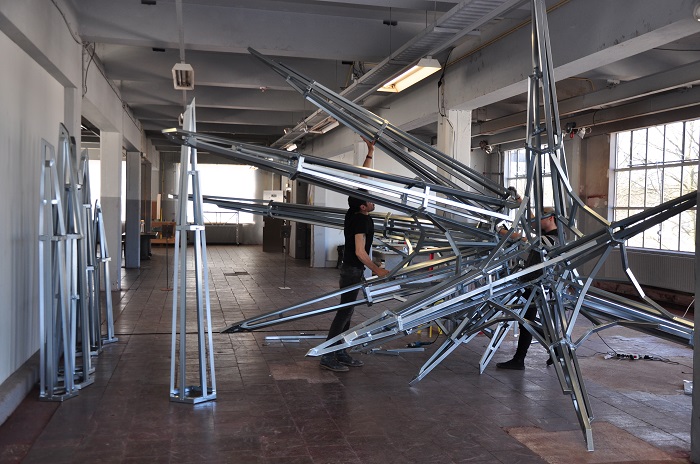
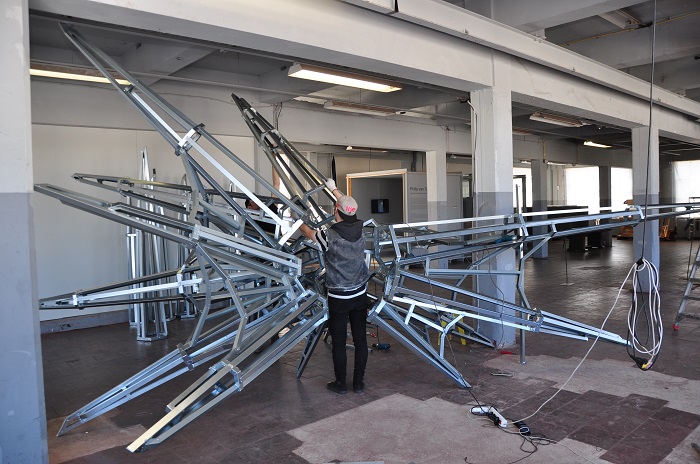
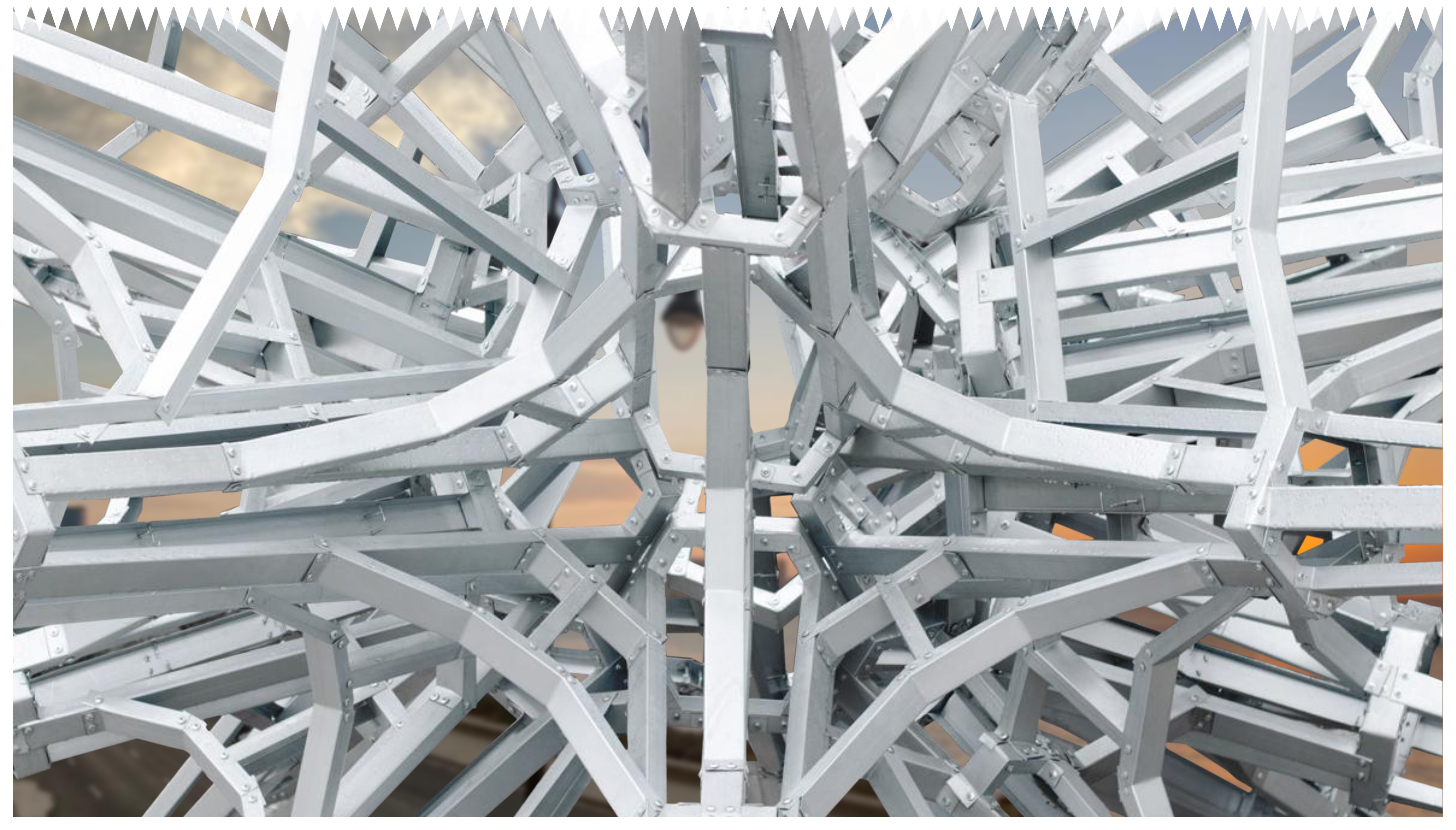
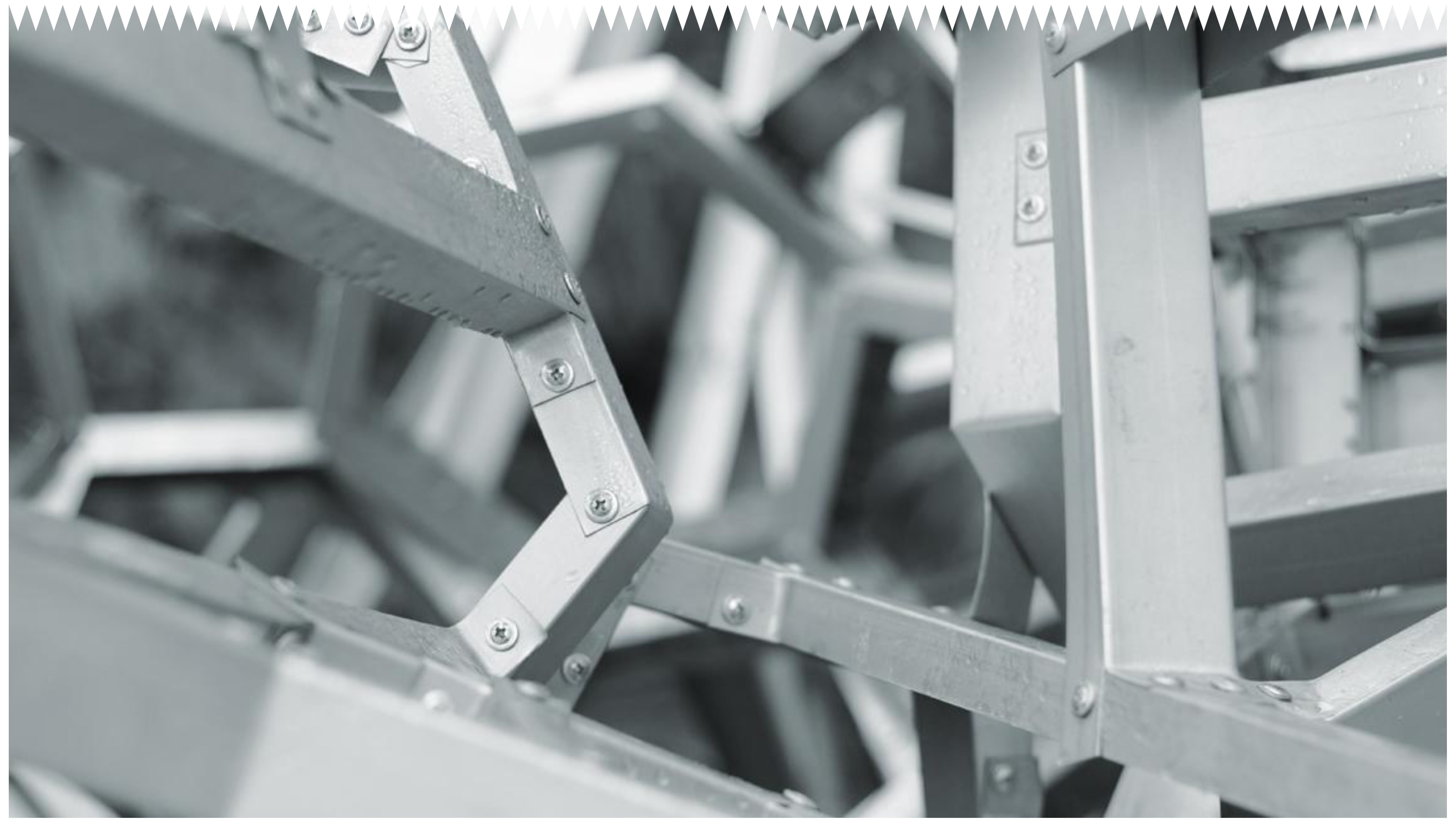
T.F.O.P. (The Fuck Off Prject) is a mutable on-site sculptural installation project made with lightweight construction materials (cut, bent and screwed galvanized steel studs). The project is reconstructed according to the context in which it is exhibited. The dimensions of the installation depend on the size of the site, invading, besieging and defending the space of its public; attacking, and at the same time, motivating a certain type of fascination with the offending object. The project seeks to generate the physical and conceptual metaphor about the use of security and violence as a system of individual, community and political protection. The process begins by studying the space to intervene, observing the traffic within it, knowing its memory or lack of it, finding the spaces within the space that can be sheltered, that can become independent when divided by creating SAFETY ZONES (SITIOS DE SEGURIDAD).
image: photo detail of previous edition of physical sculpture juxtaposed on the Havana pier. courtesy of the artist
Variations and derivatives of the project have been shown throughout the globe, in each specific context the work creates totally different reactions depending on the viewing public’s perception with safety, danger, security, power, labor, paranoia, etc… From its initial materialization in Northern Mexico where the danger of being kidnapped and held for ransom was so real in 2008 (the year this project began) that a construct with these characteristics seemed necessary, to forming part of collections and bringing a pseudo penetrative sense of empowerment that accumulating weapons creates in the citizens of American empire, the work has been shown in Russia, China, The Netherlands, among other countries, where each citizenry has their own set of rules and each culture looks at its own demise in a unique light.
image: photo detail of previous edition of physical sculpture. courtesy of the artist
The sale of this NFT, a 1 of 1, 6000 x 4800 pixel, 40 layer*, RGB, PSD file, and it’s maximum of 3 minted derivatives (1 GIF file, 1 MOV file as in the Youtube video & 1 printable TIFF file that the artist would eventually sign, included with the original PSD file) will enable the artist to successfully fund the aforementioned physical sculptural project in Cuba, also, the artist will afford to spread the resources to four or five well paying part time jobs for art students in Havana (for the duration of six months) that will definitely change their current financial situation. Last but not least, the artist will proceed with the donation of all materials, tools and supplies purchased in México and shipped to Cuba for the production process, towards the cultural institution that will be involved in the production and post-production processes with the artist. If, and only if, the cost of the NFT exceeds the previous cost of the artist’s similar works on the conventional art market plus the estimated production costs of the whole project, the artist will donate the physical sculptural piece to the people of Cuba, for their future viewing pleasure and as a public gift from the artist and the collectors of this project.
▲▲▲▲▲▲▲▲▲▲▲▲▲▲▲▲▲▲▲▲▲▲▲▲▲▲▲▲▲▲▲▲
Check out SITIO DE SEGURIDAD (T.F.O.P.) by Daniel Ruanova at Crypto.com NFT!
This project is dedicated to the memory of Juanito Delgado. An extraordinary curator, an amazing human being and a force of good for those who were touched by his presence and ideas. The future installation of the SITIO DE SEGURIDAD (T.F.O.P.) on the Havana Pier was part of Juanito´s vision and including us in his DETRÁS DEL MURO lineup is an honor that I will always carry and mention to the world.
Hace casi treinta años, jugaba fútbol americano escolar. Jugué en un equipo campeón y en otro totalmente lo contrario. Recuerdo mucho más mis experiencias en el segundo equipo (los perdedores) que mis experiencias con el primero (los ganadores). La camaradería que se vivía con los campeones estaba basada en la ilusión de ser superiores, ganadores, de ser más chingones que los demás. Ganamos todo y eso se esperaba de nosotros. Con los otros, con los que nunca ganamos un solo juego, se sentía una realidad mucho más plural, la mayoría de nuestros jugadores no iban a nuestra escuela. Cabe mencionar que ya me habían expulsado de la escuela campeona y la escuela nueva fungía como un refugio para muchos como yo. Nuestro coach, conformó un equipo similar a como se hizo la matrícula de este mi nuevo centro educativo: dando segundas y terceras oportunidades a los chamacos que perdían su lugar en otras partes.
Lo recuerdo claramente: Se me acercó un compañero cuando nos tocaba pagar el uniforme nuevo, sacó de una mochila una docena de caretas viejas de americano que le dió su padre para venderlas entre nosotros y así poder pagar su uniforme. Nadie las compró, estaban muy usadas y eran estilos viejos… Aún recuerdo cuando le pedí los pesos a mi madre para poderlas comprar, según yo las iba a arreglar y vender. Mi madre sabía lo contrario, allí se iban a quedar, pero también sabía que esos pesos eran la oportunidad para que otro chamaco pudiera portar un uniforme nueva con orgullo. Ese equipo fue un desastre en lo deportivo, muchos compañeros ya no viven, sucumbieron ante los males que el deporte trata de evitar.
Me reencontré con las caretas cuando limpiaba la casa vieja de mi familia durante la pandemia… inmediatamente regresé a esos momentos e ideé este objeto que encapsula aquella parte de mi vida. Las caretas protejen y resguardan ante el golpe que viene. Estuvieron allí por tres décadas, esperando servir de nuevo; cuidando de las ilusiones de aquellos chamacos (hoy señores) que han sobrevivido con ellas.
“…la PINTURA/DESPINTURA, es literal y metafóricamente la acción de descarapelar con violencia las capas de contenido que nos construimos como superficie para los demás; y consecuentemente transformar esta ilusión – convertida – en – materia a una cosa tangible que va más allá de la imagen*. Hoy, cuando la imaginación colectiva está conformada por millones de imágenes prefabricadas sin sentido alguno más que continuar la tendencia del hiperconsumo, lo que se ve, dejó de ser realidad hace mucho…. El espectador es testigo de la exploración que por lo general se queda en el estudio, tras bambalinas. Los objetos que conforman cada pieza (la pintura despintada y la despintura) deberán de exhibirse en donde se relacionan, en donde se observe que uno viene del otro por la mera composición cromática de los mismos y los gestos agresivos de construcción en ambas…” D.R.
“…PINTURA/DESPINTURA, is literally and metaphorically the action of violently peeling off the layers of content that we build ourselves as a surface for others; and consequently transform this illusion – converted – into – matter to a tangible thing that goes beyond the image*. Today, when the collective imagination is made up of millions of prefabricated images with no meaning whatsoever other than continuing the trend of hyperconsumption, what is seen ceased to be reality long ago…. The viewer witnesses the exploration that usually stays behind the scenes in the studio. The objects that make up each piece (the despintura and unpainted painting) should be exhibited where they are related, where it is observed that one comes from the other due to their mere chromatic composition and the aggressive construction gestures in both… ” D.R.
*La pintura como materia tridimensional bajo procesos de aglomeración-compresión después de haber sido despintada del canvas. /Paint as a three-dimensional matter under agglomeration – compression processes after being unpainted from the canvas.
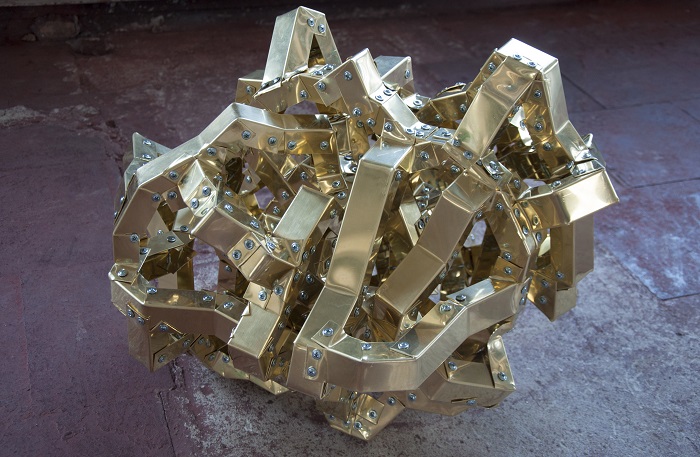
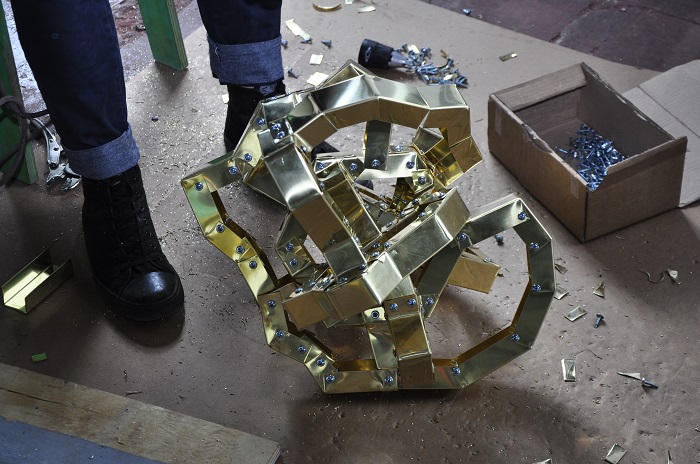
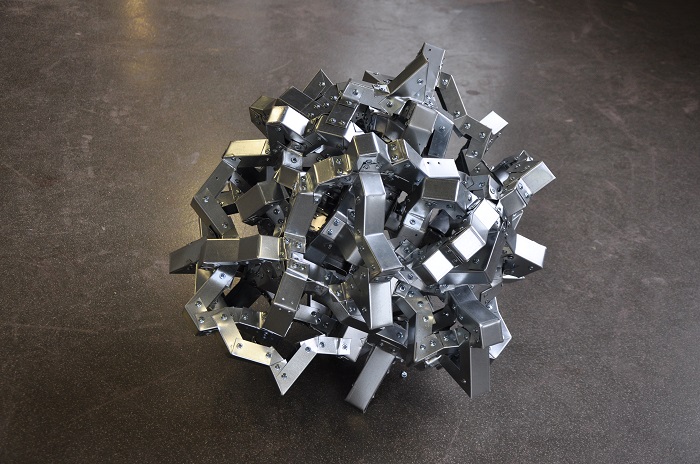
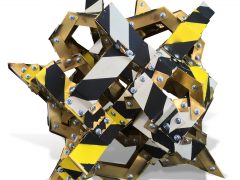
An ongoing sculptural assemblage project that utilizes custom made brass studs (that copy the form of regular light weight construction material) painted with enamel-acrylic to simulate barriers – guard rails – limits – and – borders.
///
Proyecto en curso de ensamblaje escultórico que utiliza perfiles de latón hechos a medida (que copian la forma de material de construcción lijera regular) pintados con esmalte-acrílico para simular barreras – barandillas – límites – y – bordes.
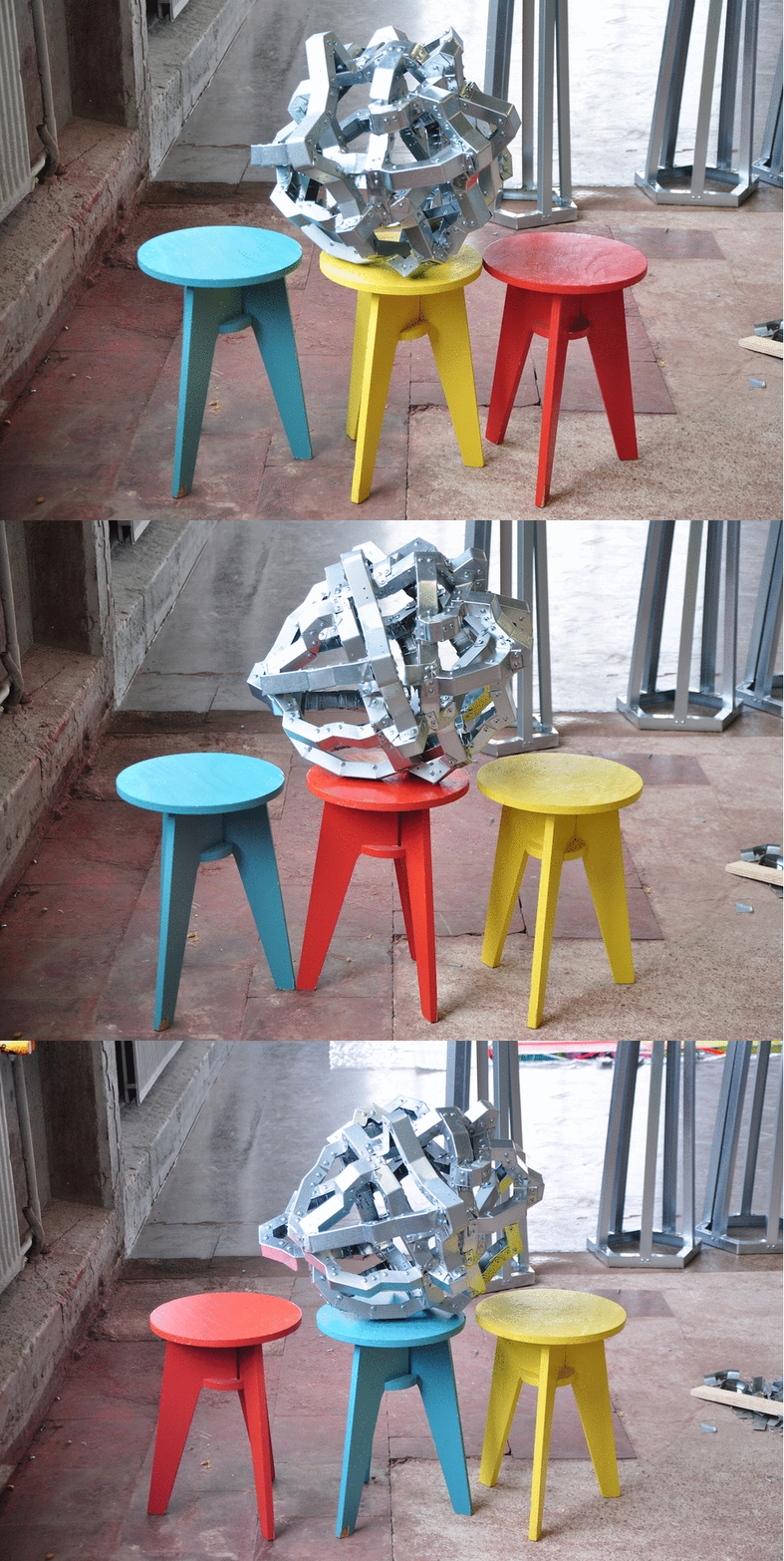
BARRIER BALL (1), 1’ x 1’ x 1’, acrylic enamel paint, custom made brass studs & galvanized steal screws. 2020
BARRIER BALL (2), 24″ x 20″ x 18″, acrylic enamel paint, custom made brass studs & galvanized steal screws. 2020
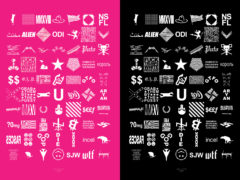
aboutfascists… es una enunciación sobre el acaecimiento neo-fascista de una sociedad voluntariamente cegada por rituales cotidianos que sirven a una inteligencia artificial que apenas vislumbramos…
///////
is an enunciation about the neo-fascist occurrence of a society voluntarily blinded by everyday rituals that serve an artificial intelligence that we barely glimps…
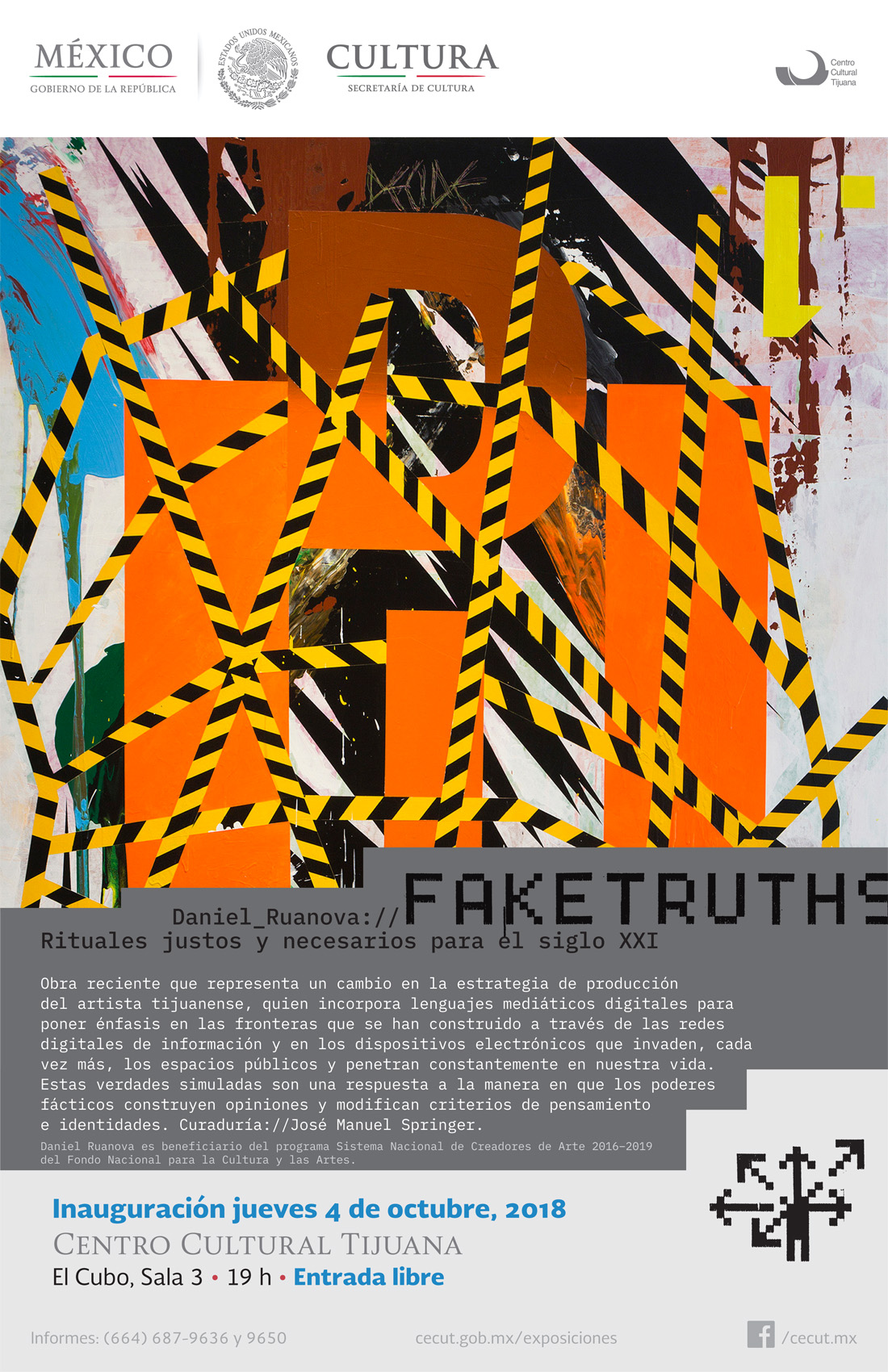
3000 piezas / 2 ediciones (rosa y negro) de 1500 cada una, offset a una tinta sobre papel bond/mustang de 60 lbs., 41.7 x 61 cm. (16.4 x 24 pulgadas)
Impresos como obsequio para el público que visite: FAKETRUTHS / rituales justos y necesarios para el siglo XXI, Centro Cultural Tijuana – EL CUBO Sala 3. 4 de octubre de 2018 a 24 de febrero de 2019
impreso en DXP Offset por Luis González, Tijuana, México. septiembre de 2018.
///////
3000 pieces / 2 editions (pink and black) of 1500 each, offset on bond/mustang paper 60 lbs., 41.7 x 61 cm. (16.4″ x 24″)
Printed as a gift for the public that visits: FAKETRUTHS / Righteous and necessary rituals for the 21st century, Centro Cultural Tijuana – EL CUBO Room 3. October 4, 2018 to February 24, 2019
printed @ DXP Offset by Luis González, Tijuana, México. September 2018.
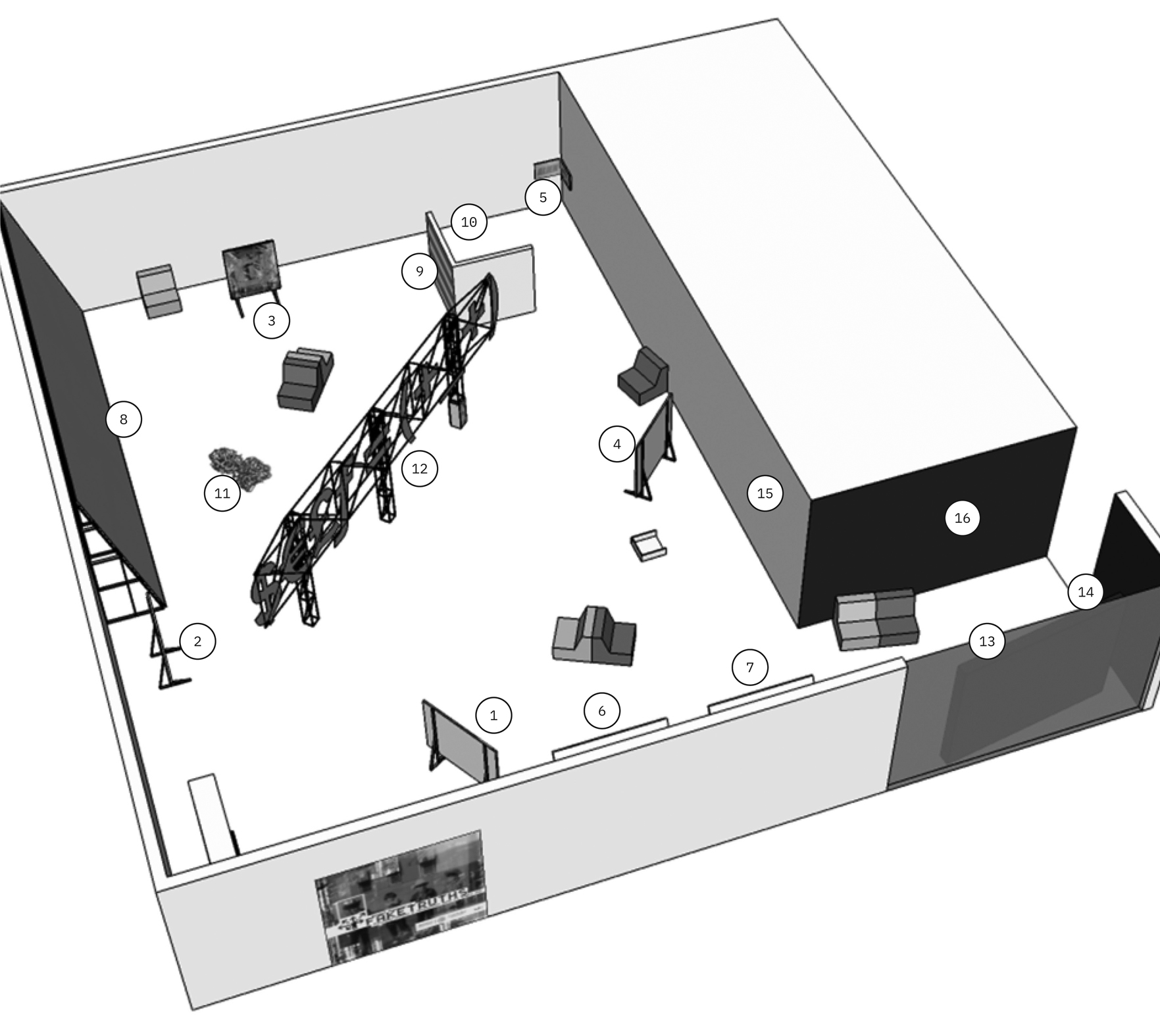
A partir de su experiencias con las culturas de la frontera Daniel Ruanova ha dispuesto para el visitante este espacio cuya característica es expandir la narrativa del cubo blanco expositivo. Los contenidos y las formas se desprenden de sus muros y se proyectan sobre el transeúnte. El no-lugar nos compele a tomar asiento y navegar por la exposición.
Las pinturas devienen en pantallas que reflejan la superposición de lenguajes digitales, buzzwords y frases anidadas en el inconsciente. Imágenes evanescentes y fórmulas algorítmicas conforman el cyber art que envuelve al usuario. Declarativa y procesual, la exposición ofrece la experiencia de una urbe postnacional; un laberinto de iconos de los poderes fácticos, saturado por la omnipresencia de billboards y pantallas esplendentes.
Esta muestra es un fragmento de una realidad paralela producto de las hegemonías de Google, Trump, Fox News. Construida con los mismos recursos que promueven la especulación financiera con bitcoins, avatares necesariamente alienados ($ € £ f), y promovida desde la interconectividad fascista de las redes digitales.
El espacio de exposición es un dispositivo de arte-ficción en el que se disuelven las fronteras entre mundo real y las fake truths que construyen los rituales para habitar el siglo XXI.
José Manuel Springer
Curador
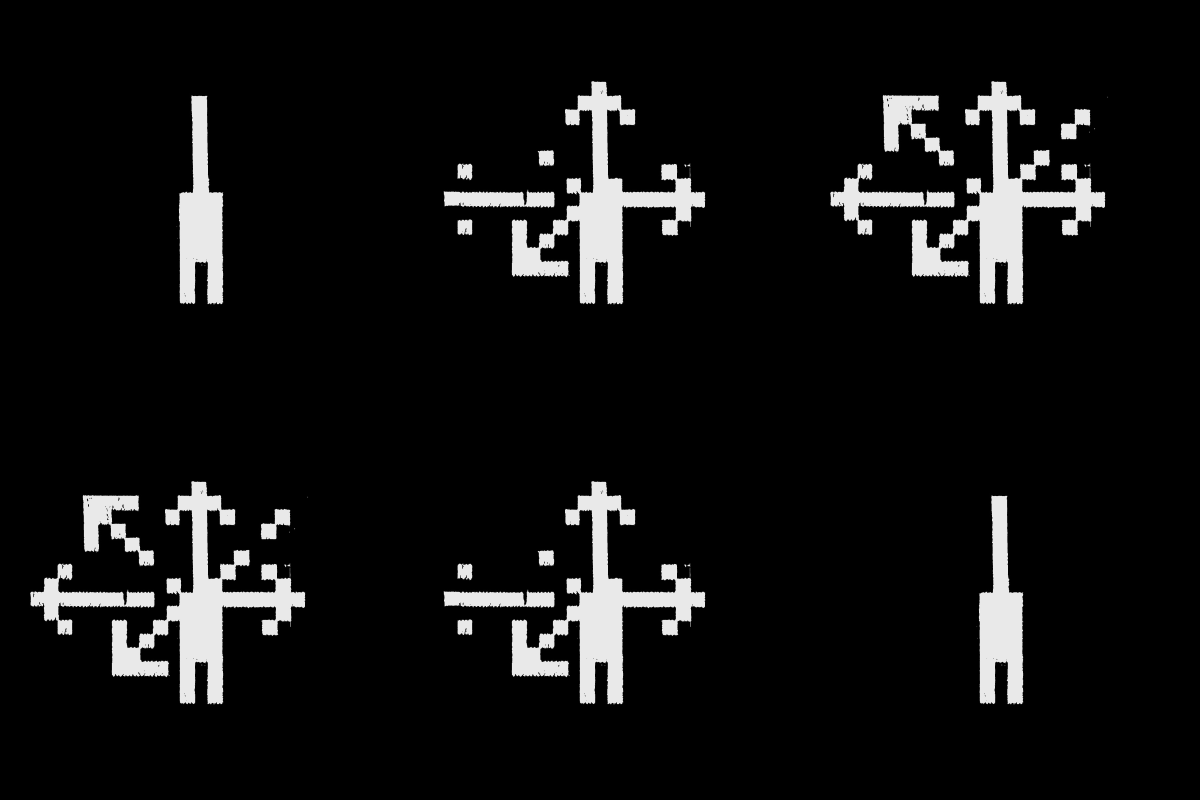
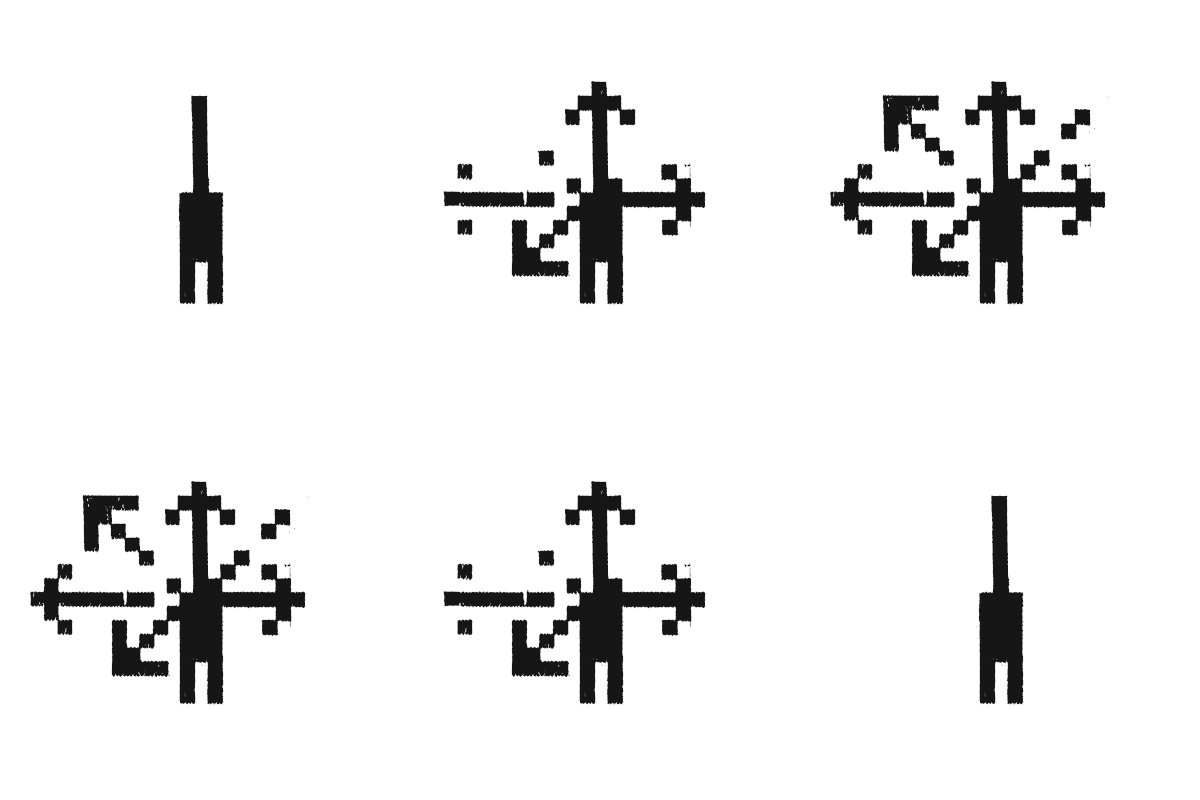
___________ (+_+) ___________
Este proyecto es una enunciación sobre el acaecimiento neo-fascista de una sociedad voluntariamente cegada por rituales cotidianos que sirven a una inteligencia artificial que apenas vislumbramos. Obligando a un recorrido visualmente físico, el proyecto es una “puesta en sala” que ocupa el espacio con señalizaciones de un devenir distópico.” (in Spanish)
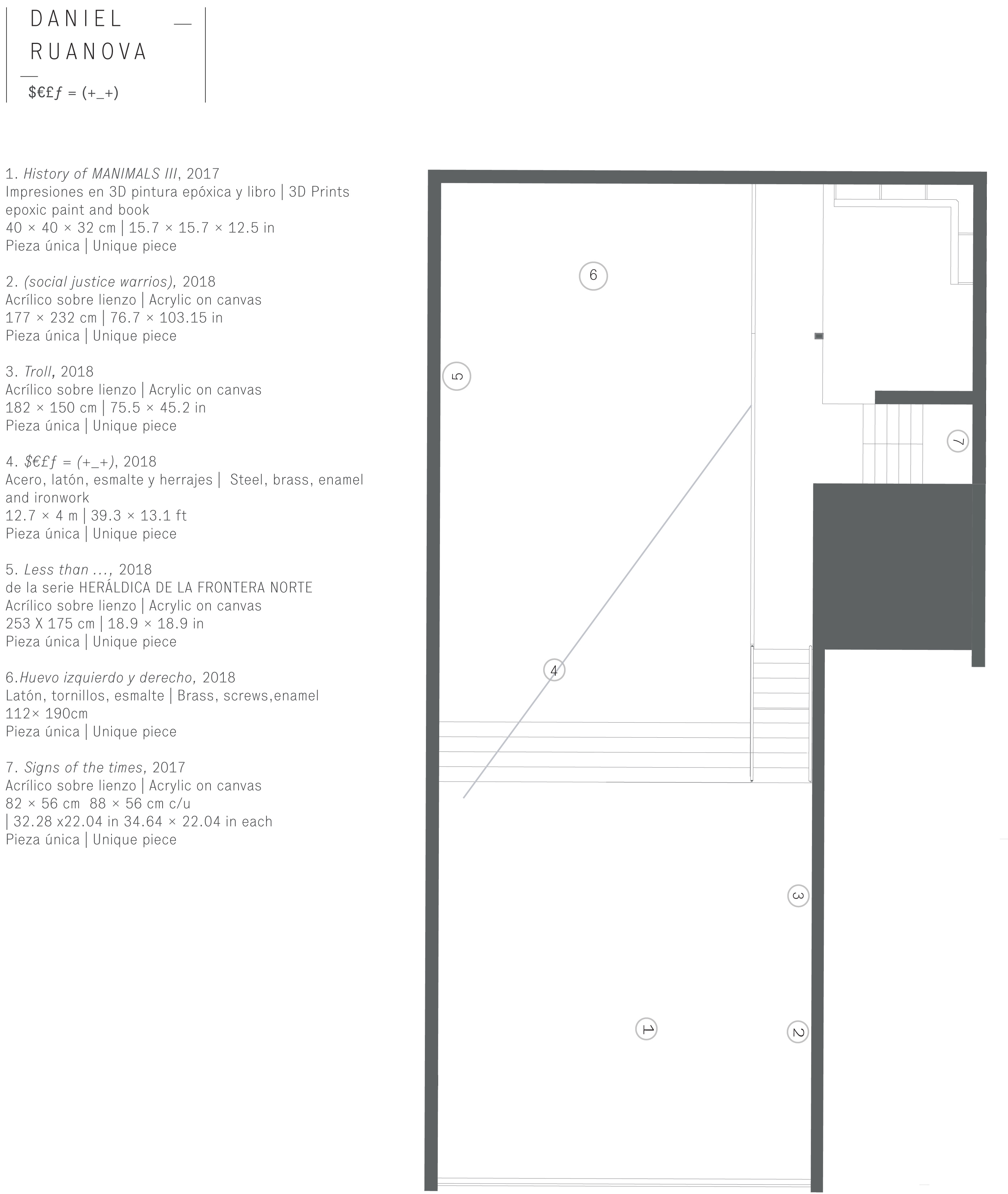
(social justice warrior) / Acrílico sobre lienzo, 2018
troll / Acrílico sobre lienzo, 2018
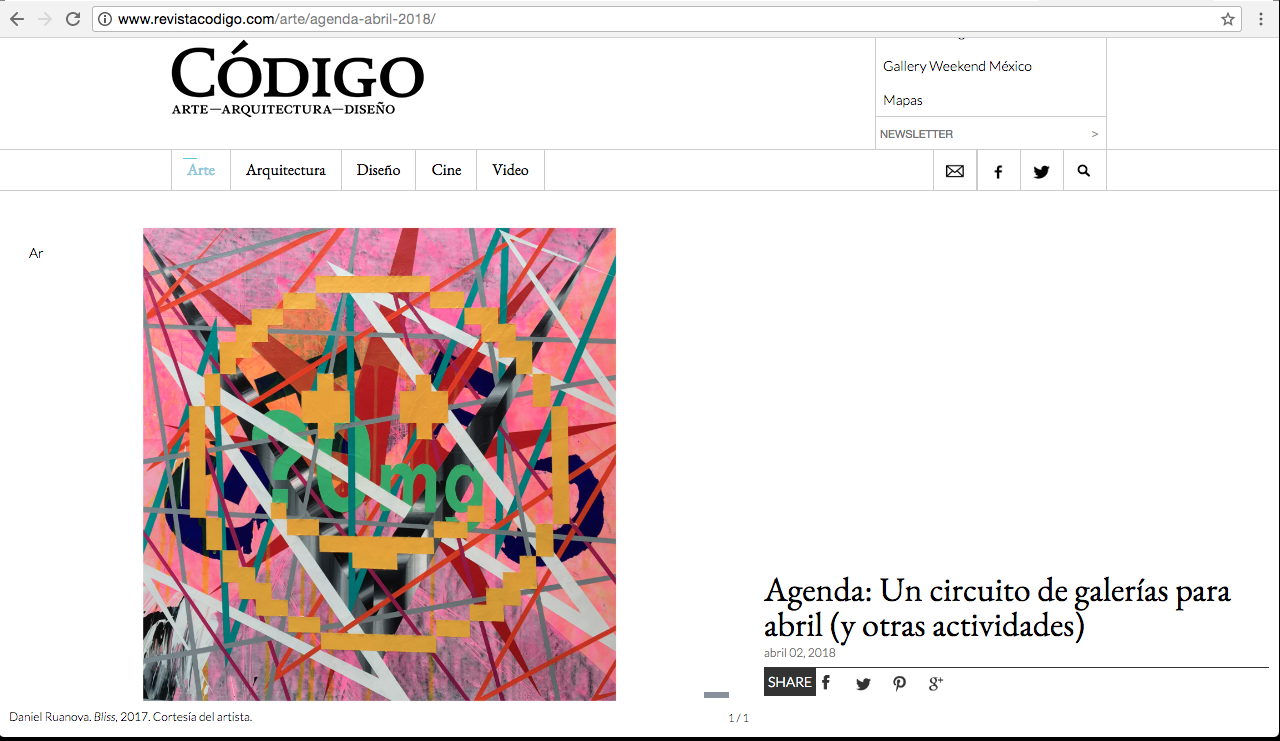
Bliss II / Acrílico sobre lienzo, 2018
Grand Old Putz / Acrílico sobre lienzo, 2018
Signs of the times (ALIEN METH) / Acrílico sobre lienzo, díptico, 2017
Old Immigrant Scum / Acrílico sobre lienzo, 2016 (Colección de Raul Rosado)
CERDO / Acrílico sobre lienzo, 2016 (Colección Elias+Fontes)
LEOS (oposición complementaria) / Acrílico sobre muro falso, 2018
stripes / Acrílico sobre muro falso, 2018
Extinction of the free and the brave* / de-construcción de la última estrofa del himno nacional de los Estados Unidos de América: The Star Spangled Banner. Bocina y reproductor.
Huevo izquierdo y derecho / Latón, tornillos de acero inoxidable y esmalte, 2018
Video-Documental de Saulo Cisneros con el “fantasma digital” de Daniel Ruanova.
about fascists / 3000 piezas en dos ediciones (1500 negras / 1500 rosas)
LITTLETHINKER** / Proyección de animación digital en loope ∞, 2018
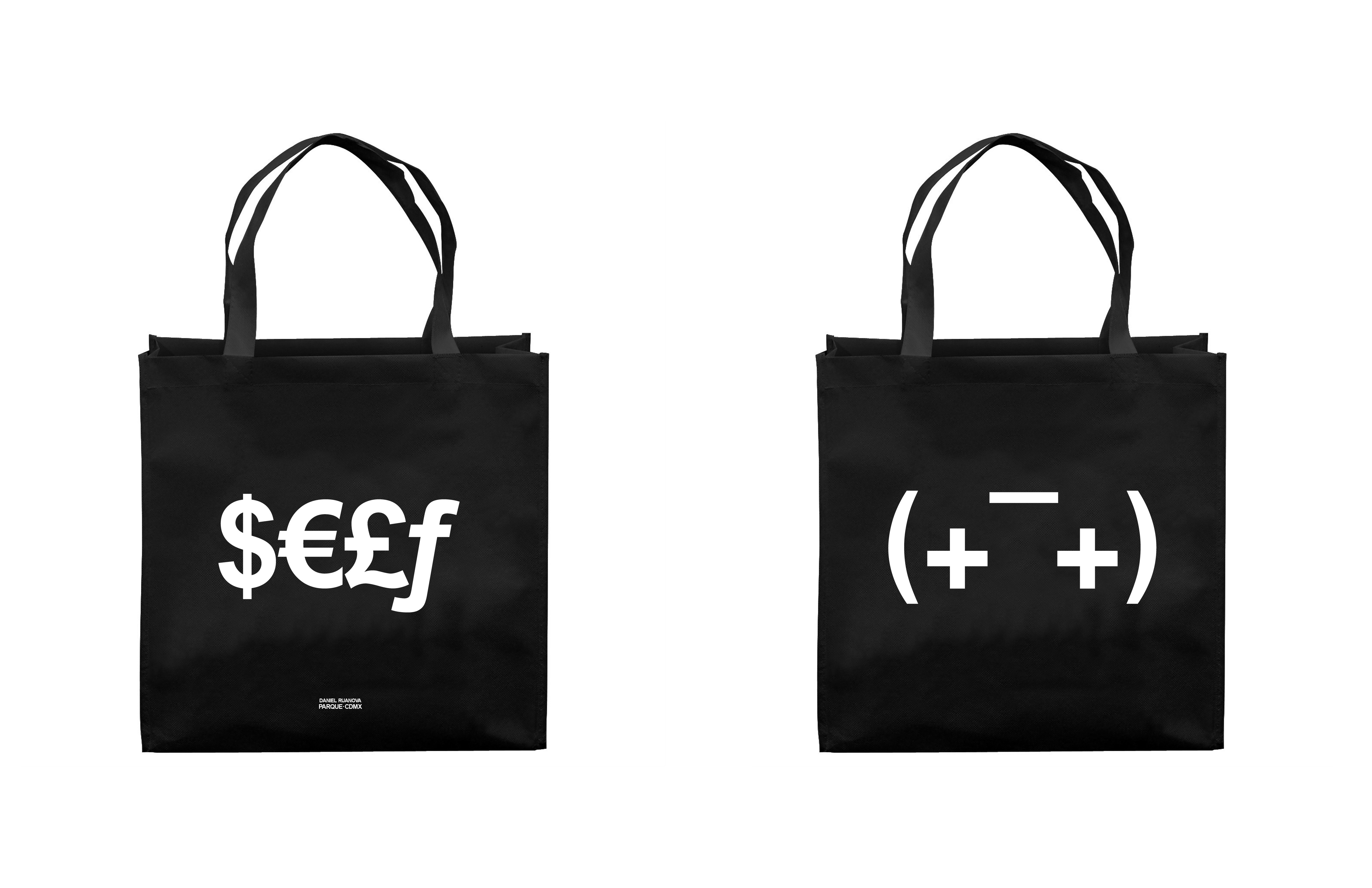
AHÍ_VIENEN / (+_+) (+_+) (+_+) (+_+) (+_+) (+_+) (+_+) (+_+) (+_+) (+_+) (+_+) (+_+) serigrafía sobre bolsa-tote (ambos lados) sobre cabeza de millenniales. 12 participantes durante inauguración, duración de la acción: 30 minutos. 2018
+ 8 sillones de hule espuma diseñados y producidos por Daniel Ruanova, 2018
___________ (+_+) ___________
*Escucha / Listen:
La carrera de Daniel Ruanova (Tijuana, 1976) es un recorrido ecléctico por diferentes formatos y plataformas en la que se cruzan géneros artísticos y mundos visuales. Los puentes que unen transversalmente a estas manifestaciones son los temas de la migración y la cultura de la fronteridad.
Motivado por la evolución de Tijuana entre el vaivén de la necesidad y su estratégica posición geopolítica y cultural, el aporte artístico de Ruanova se enfocó en la capacidad de adaptación de la cultura tijuanense a las condiciones políticas y económicas de la región Pacífico, así como el modelo de integración a contrapelo de modos de consumo y tecnologías del Norte con formas de producción y vida al Sur de la frontera.
El modelo de creación del artista ha pasado por varias etapas en dos décadas: desde la consideración histórica del trabajo de los braceros e indocumentados, a las realidades que genera la violencia y la inseguridad; Tijuana lo abarca todo: ser el lugar de adaptación de modelos económicos (como la televisión de paga), el asiento de la vida disipada para el visitante y el viajero, lugar de comercio de medicina de patente y servicios médicos para el visitante hasta ser la plaza de cárteles delictivos propios y foráneos que continúan disputándose su control.
El cruce fronterizo más transitado de todo América, destino temporal de grupos de migrantes procedentes de todo el mundo, le ofreció a Daniel Ruanova al inicio de su carrera en los 90 un extenso abanico de posibilidades interpretativas sobre el significado del ser tijuanense: el individuo que cruza fronteras, que abre horizontes, distinguible por su capacidad de apropiación y asimilación de los lenguajes visuales, musicales, tecnológicos y culturales en boga.
Más adelante, con la explosión económica de China, Ruanova se estableció en Beijing donde participó en la escena cultural como artista y gestor cultural del éxodo foráneo, abrió vetas para su carrera profesional que lo llevaron a reafirmar su convicción de que el migrante es el ciudadano modelo del mundo contemporáneo.
Fake truths, verdades ilusorias, es una mirada retrospectiva a los años recientes de la producción del artista. La obra incluida en esta exposición resume los diferentes aspectos que han marcado la cultura de la fronteridad, en los que se da una paradójica deconstrucción de las fronteras virtuales unida a la intención de levantar muros físicos.
Para el artista, el Internet y las grandes corporaciones surgidas de esta red (Google, Facebook, Microsoft) han fabricado los nuevos territorios y fronteras, con sus correspondientes lenguajes tecnológicos, subculturas e hitos culturales, enfocados hacia el consumo, pero también hacia la manipulación de los comicios electorales a través de la manipulación de las opiniones de cientos de millones de usuarios y sus datos personales.
La obra pictórica incluida en la exposición expresa las metáforas de las palabras usadas para denostar a migrantes. También se incluyen ejemplos gráficos que forman parte de las plataformas Facebook, Whattsapp, Twitter y similares. La sala es una simulación del espacio virtual, donde colisionan emoticones, imágenes digitales (bitmaps) y animaciones, que forman parte de los códigos de identidad de la generación millennial.
La exposición es testimonio de las habilidades interpretativas del artista, que sabe leer oportunamente las tendencias y las historias de las redes digitales, que se han convertido en el origen y destino del mundo hiperdesarrollado, sobre informado y multipolar en que vivimos.
En ese mundo virtual expositivo conviven las fórmulas que la generación de jóvenes postnacionales manipula todos los días para construir sus propias identidades, con las que expresan sus visiones sobre el futuro de la tecnología, y de las que emergen las formas de convivencia que habrán de convertirse en rituales de paso, necesarios para entender la era en la que vivimos.
La obra de Ruanova se dirige a esas generaciones que harán de éste un mundo líquido imposible de contener y definir en términos de paradigmas culturales y políticos únicos. La lógica cultural de esta época es la exposición ininterrumpida de la gente a flujos y ráfagas de datos que desplazan velozmente a las plataformas tecnológicas efímeras, y en las que las nociones de territorio, cultura, cuerpo o idioma son continuamente intercambiables.
Integrada por una docena de obras en técnicas pictóricas, escultóricas y digitales, Fake Truths ofrece un recorrido por los años más recientes de la obra de Daniel Ruanova, que busca redefinir el concepto arte fronterizo, como zona virtual donde se ejerce la cultura como performance (demostración a través de la acción), y se recrea la estética informática, al grado de que la misma biografía del artista es una pieza de la exhibición.
La exposición fue seleccionada y co-diseñada por José Manuel Springer, crítico y curador independiente.
/////// English translation ///////
The career of Daniel Ruanova (Tijuana, 1976) is an eclectic journey through different formats and platforms in which artistic genres and visual worlds intersect. The bridges that cross these manifestations transversally are the themes of migration and the culture of the border.
Motivated by the evolution of Tijuana between the oscillation of necessity and its strategic geopolitical and cultural position, Ruanova’s artistic contribution focused on the ability of Tijuana to adapt to the political and economic conditions of the Pacific region, as well as the integration model against the grain of consumption modes and technologies from the North with forms of production and life south of the border.
The model of creation of the artist has gone through several stages in two decades: from the historical consideration of the work of braceros and undocumented, to the realities generated by violence and insecurity; Tijuana covers everything: being the place of adaptation of economic models (such as pay television), the seat of life dissipated for the visitor and the traveler, a place of trade in patent medicine and medical services for the visitor to be the square of own and foreign criminal cartels that continue to dispute their control.
The busiest border crossing in all of America, temporary destination of groups of migrants from all over the world, offered Daniel Ruanova at the beginning of his career in the 90s an extensive range of interpretative possibilities about the meaning of Tijuana being: the individual who It crosses borders, that opens horizons, distinguishable by its capacity of appropriation and assimilation of the visual, musical, technological and cultural languages in vogue.
Later, with the economic explosion of China, Ruanova settled in Beijing where he participated in the cultural scene as an artist and cultural manager of the foreign exodus, opened veins for his professional career that led him to reaffirm his conviction that the migrant is the citizen model of the contemporary world.
Fake truths, illusory truths, is a retrospective look at the recent years of the artist’s production. The work included in this exhibition summarizes the different aspects that have marked the culture of the border, in which there is a paradoxical deconstruction of the virtual borders together with the intention of building physical walls.
For the artist, the Internet and the large corporations that emerged from this network (Google, Facebook, Microsoft) have manufactured the new territories and borders, with their corresponding technological languages, subcultures and cultural milestones, focused on consumption, but also on manipulation. of the electoral elections through the manipulation of the opinions of hundreds of millions of users and their personal data.
The pictorial work included in the exhibition expresses the metaphors of the words used to insult migrants. Also included are graphic examples that are part of the Facebook, Whattsapp, Twitter and similar platforms. The room is a simulation of the virtual space, where emoticons collide, digital images (bitmaps) and animations, which are part of the identity codes of the millennial generation.
The exhibition is a testimony to the interpretive skills of the artist, who knows how to read the trends and stories of digital networks in a timely manner, which have become the origin and destiny of the overdeveloped, informed and multipolar world in which we live.
In this virtual exhibition world, the formulas that the generation of postnational youths manipulate every day to build their own identities coexist, with which they express their visions about the future of technology, and from which emerge the forms of coexistence that will become in step rituals, necessary to understand the era in which we live.
Ruanova’s work is aimed at those generations that will make this a liquid world impossible to contain and define in terms of unique cultural and political paradigms. The cultural logic of this time is the uninterrupted exposure of people to flows and bursts of data that quickly move to the ephemeral technological platforms, and in which the notions of territory, culture, body or language are continuously interchangeable.
Composed of a dozen works in pictorial, sculptural and digital techniques, Fake Truths offers a journey through the most recent years of the work of Daniel Ruanova, which seeks to redefine the concept of border art, as a virtual area where culture is exercised as performance ( demonstration through action), and the computer aesthetic is recreated, to the extent that the artist’s biography is a piece of the exhibition.
The exhibition was selected and co-designed by José Manuel Springer, critic and independent curator.
___________ (+_+) ___________
Contenido de VIDEO-MAMPARA al finalizar la exhibición:
(Video RETROSPECTIVA de 20 años de producción artísitica de DR)
___________ (+_+) ___________
Entrevista sobre las ideas detrás de la exposición Fake Truths, Rituales justos y necesarios para el siglo XXI.
Producido por el Centro Cultural Tijuana, 2018 – 2019
Poseedor de una obsesión por los lenguajes mediáticos y los imaginarios fronterizos, Daniel Ruanova cuenta en su haber con una larga carrera artística que toma como punto de partida Tijuana, pero se extiende para abarcar un conjunto ecléctico de plataformas que fomentan la hibridación de las estéticas de los medios masivos y soportes digitales.
Desde el mismo algoritmo de la exposición, el artista nos da una muestra de la incertidumbre que provocan los símbolos de la dominación económica en los espacios públicos poblados por billboards electrónicos que como en Blade Runner y el Metro Insurgentes invaden el espacio público y privado con mensajes encriptados.
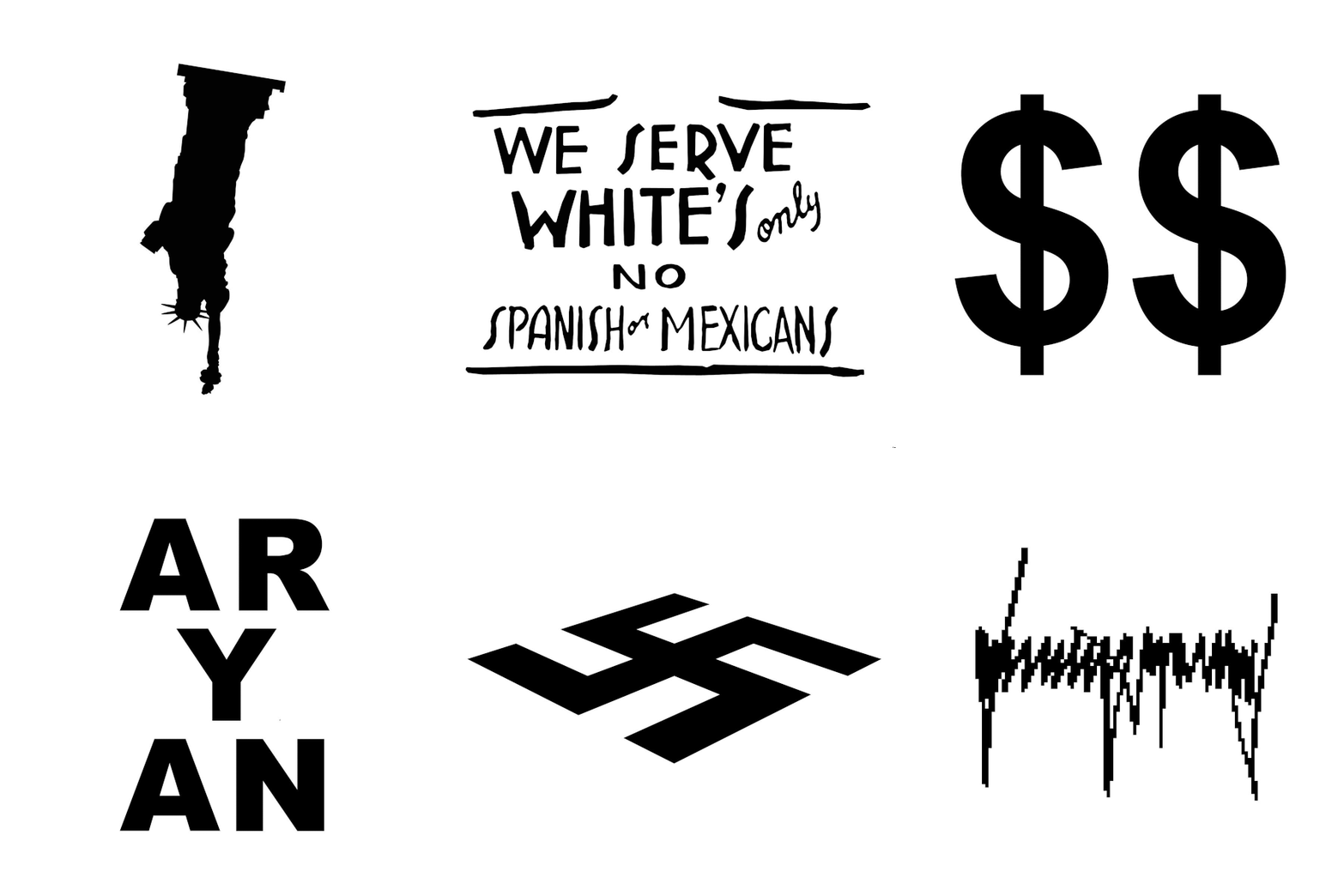
Las pinturas de Ruanova son pantallas que proyectan logotipos, cruzados por efectos visuales y recortes de imágenes pixeleadas. Entre signos de colores chillantes y destellos aparecen buzzwords del argot político racista alt-right estadounidense entremezclados con los brandings difundidos en las redes digitales chovinistas de youtubers e influencers.
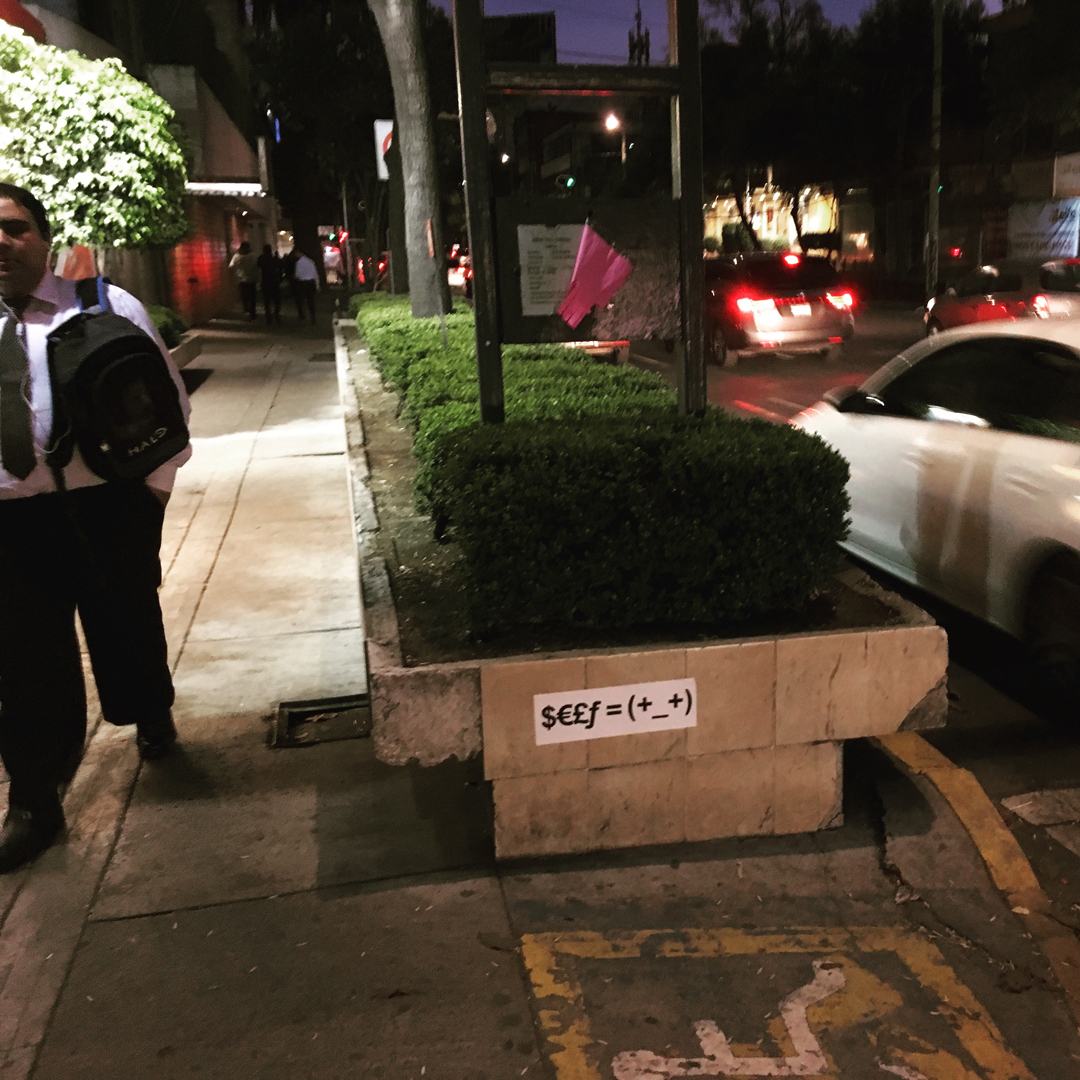
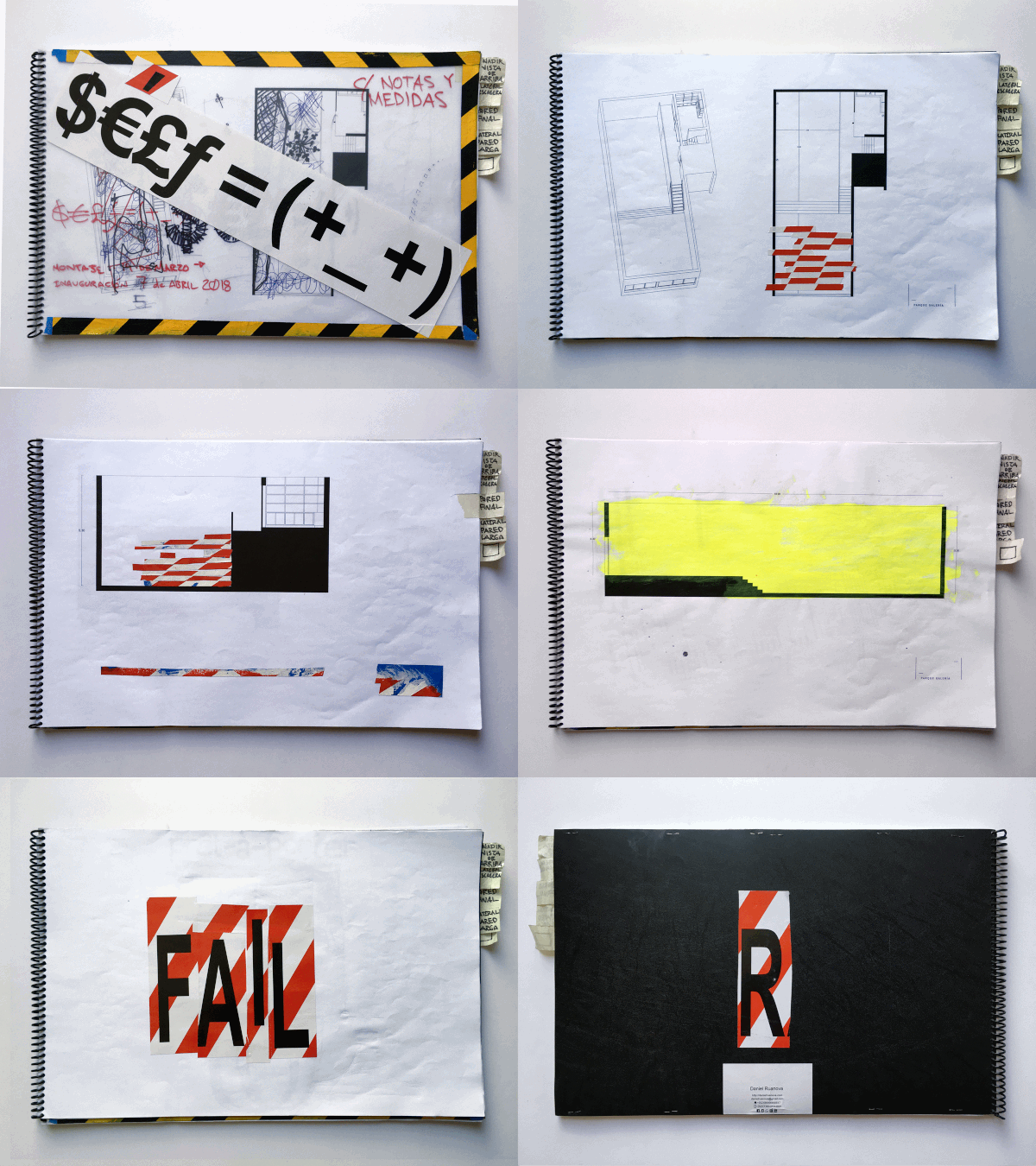
La fórmula $€£ƒ = (+_+) designa el surgimiento de subjetividades alienígenas resultado de una deriva de imágenes provenientes de Beijing, en el extremo Oriente, hasta la última frontera de Occidente: Tijuana. La obra de Ruanova propone otras identidades nómadas a partir del ruido perceptual que envuelve a esta realidad cada vez más dependiente de Google.
Obsessed with media´s visual language and border imaginaries, Daniel Ruanova has embarked on a long career in art with Tijuana as its starting point. It expands to cover an eclectic set of platforms that encourage the hybridization of the aesthetics of mass-media and digital platforms.
From the exhibition´s title algorithm, the artist hints at the uncertainty provoked by the symbols of economic domination in public spaces, littered with electronic billboards that, just as in Blade Runner or the Insurgentes subway stop, invade the public and private domain with encrypted messages.
Ruanova’s paintings are screens that reflect logos, covered in visual effects and clippings of pixelated images. Amongst bright colored signs and flashes, buzzwords containing the racist political jargon of the American Alt-Right, jumbled up with branding from the chauvinistic digital networks of YouTubers and influencers.
The formula $€£ƒ = (+_+) appoints the emergence of alien subjectivities resulting from a drift of images from Beijing, in the far East, to the last frontier of the West: Tijuana. Ruanova’s work presents nomadic identities from the perceptual noise that surrounds this reality, one that is increasingly dependent on Google.
05 abril – 26 mayo, 2018 //// April 05 – May 26, 2018
Martes a jueves de 10:00-14:00 y de 15:00-18:00 hrs, viernes de 10:00-15:00 y sábado de 11:00-14:00 hrs. Lunes cerrado. ///// Tuesday to Thursday from 10:00 a.m. – 2:00 p.m. and from 3:00 p.m. to 6:00 p.m., Friday from 10:00 p.m. to 3:00 p.m. and Saturday from 11:00 p.m. to 2:00 p.m. Closed Mondays.
Art Direction / Writer & FOUNDING MEMBER of GHOST MAGNET ROACH MOTEL
PUNKFORMANCE & SOUND ART COLLECTIVE from the Borderlands of TJ
from 2005 – until 2017
______________________________
Dirección de Arte / Escritor y Miembro Fundador de GHOST MAGNET ROACH MOTEL
COLLECTIVO DE ARTE SONORO y PUNKFORMANCE de la Frontera de Tijuana
desde 2005 – hasta 2017
______________________________
Ghost Magnet Roach Motel, the Punk Musical documentary, follows the off-stage life of 5 artists (2 American musicians, 2 Mexican artists and 1 Japanese filmmaker) of Ghost Magnet Roach Motel, a noise punkformance unit born in Tijuana, Mexico in their process of overcoming their psychological border. With a literally crashing border between Mexico and USA as the background, the protagonists confront each individual’s addictions while searching for an answer to their existentialistic crisis.
______________________________
Ghost Magnet Roach Motel, el documental punk musical, es una historia sobre 5 artistas (dos estadounidenses, dos mexicanos, y un japonés) cuyas vidas se entrelazan a través del sonido, y que colectiva e individualmente buscan la cura dentro de sí mismos. Impulsado por el sonido punk producido por el colectivo durante los últimos 5 años que se ha estado documentado el proceso, el largometraje está lleno del caótico pero sensible sonido de las generaciones contemporáneas. Con la frontera de EUA-México y su región como fondo, el documental revela la decadencia estadounidense, corrupción mexicana, y el caos japonés, mostrando las patologías de cada individuo. Con los artistas como protagonistas y como parte del equipo de posproducción, el cinta se convierte en una experiencia audiovisual dentro del mundo de Ghost Magnet Roach Motel en el que la audiencia está invitada a abrir sus sentidos y corazones.
______________________________
Ghost Magnet Roach Motel ist eine experimentelle dokumentarische Punkformance, in der Dialog und Musik verwoben werden. Der Film schaut hinter die Kulissen ins Leben der Bandmitglieder des gleichnamigen, international besetzten Noise Punk Kollektivs aus Tijuana, Mexiko. In ihrem Wandel von einer Noise Band zu einem Kollektiv wird ein neues künstlerisches Projekt geboren. Die intimen Portraits der fünf Künstler und ihr Dialog wirken als treibende Kraft des Films. So erlebt man die existentielle Konfrontation ihrer individuellen Kämpfe zwischen Sucht, Krise und Selbsterkenntnis.
acrílico sobre tela, 192.5 x 163 x 4.5 cm, 2017. colección privada TJ/MX
//////
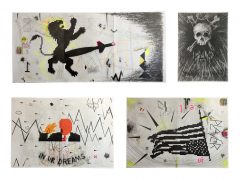
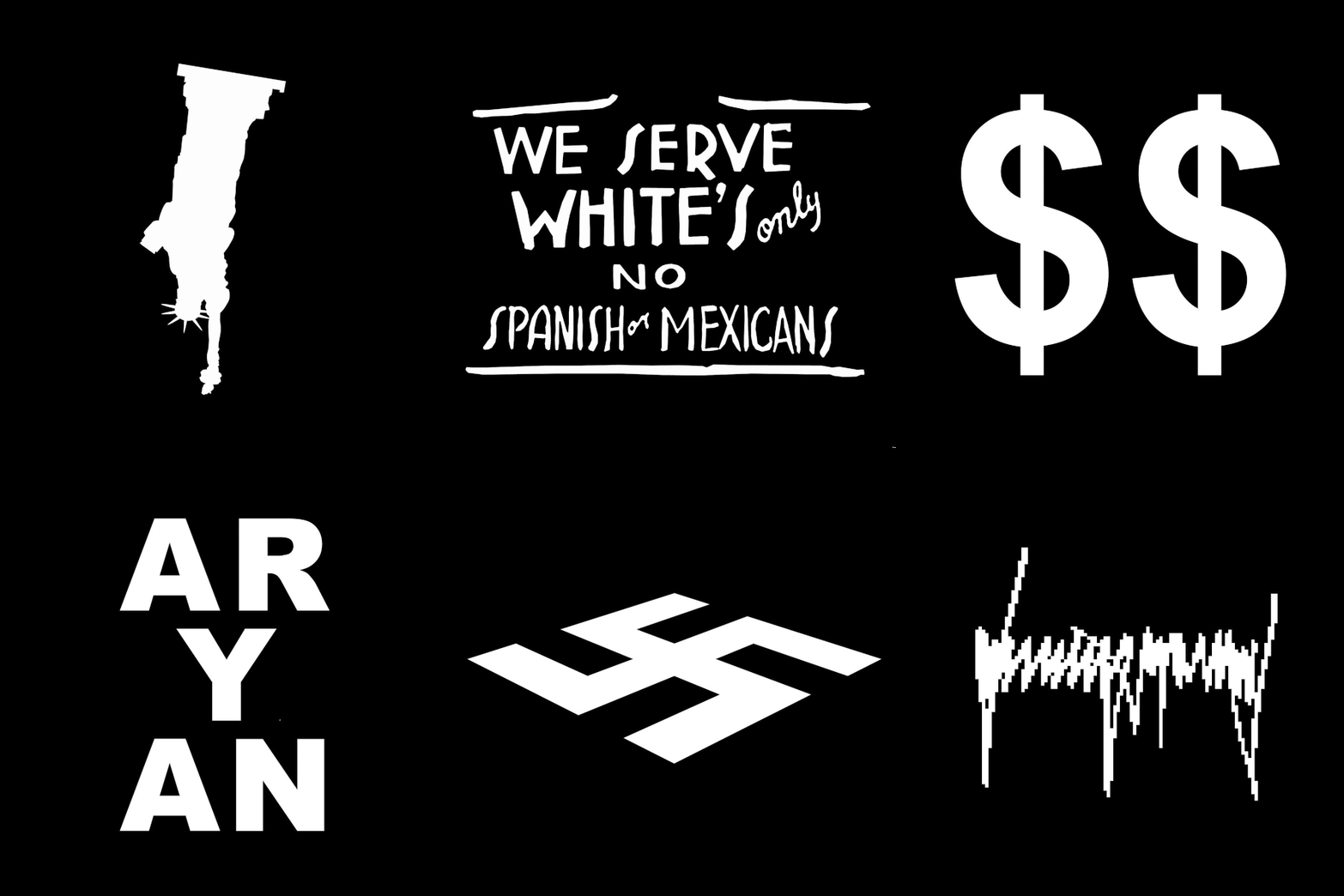
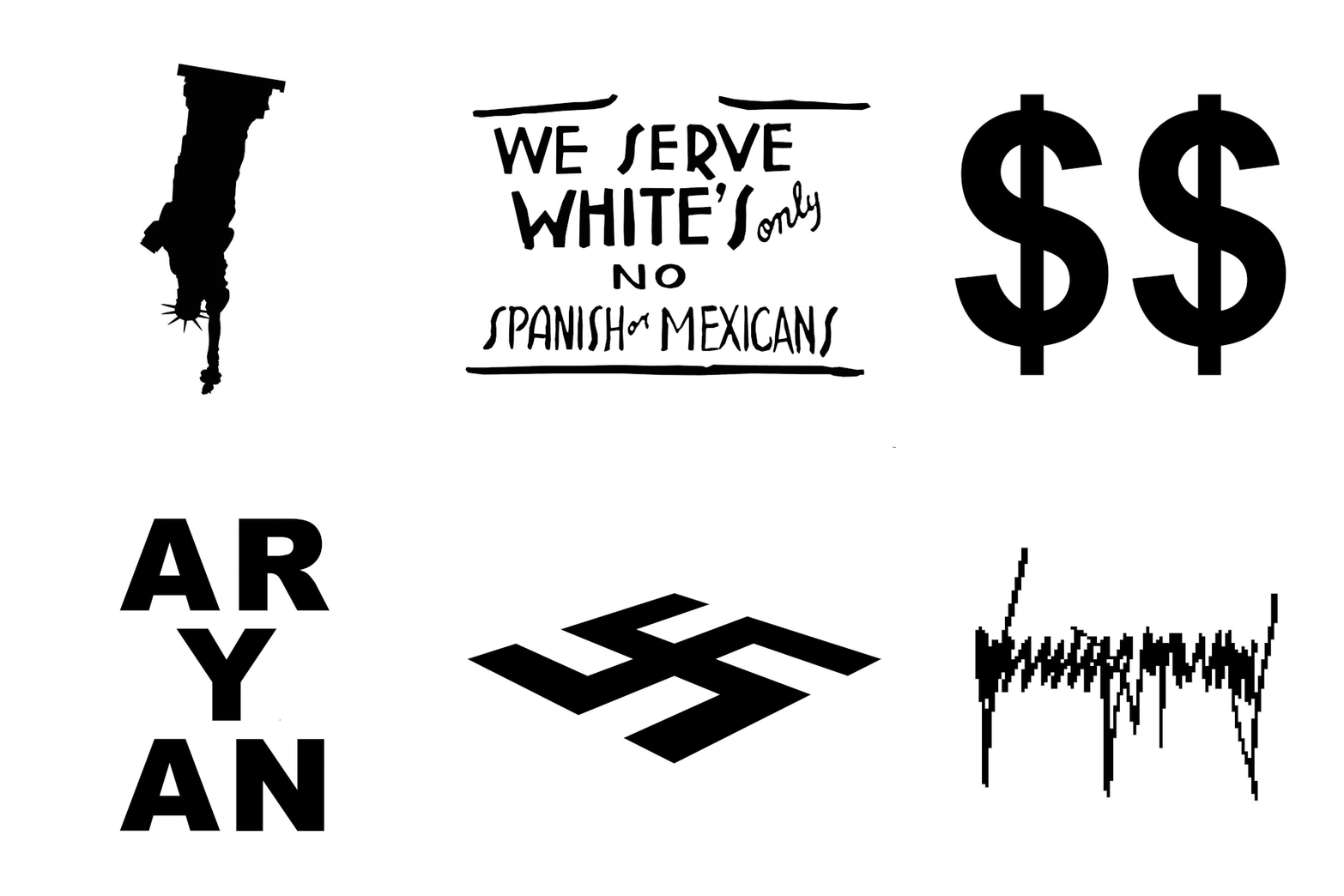
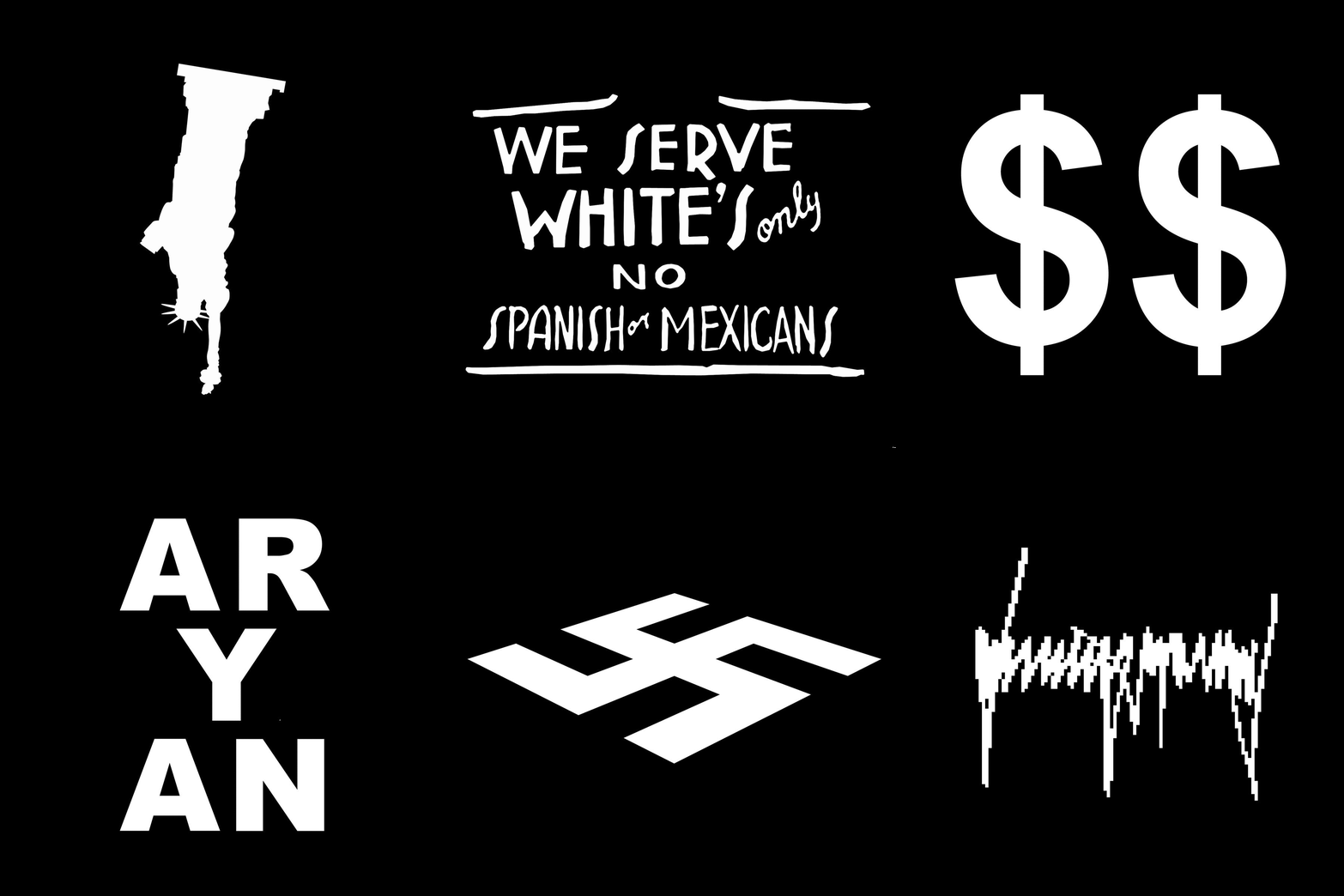
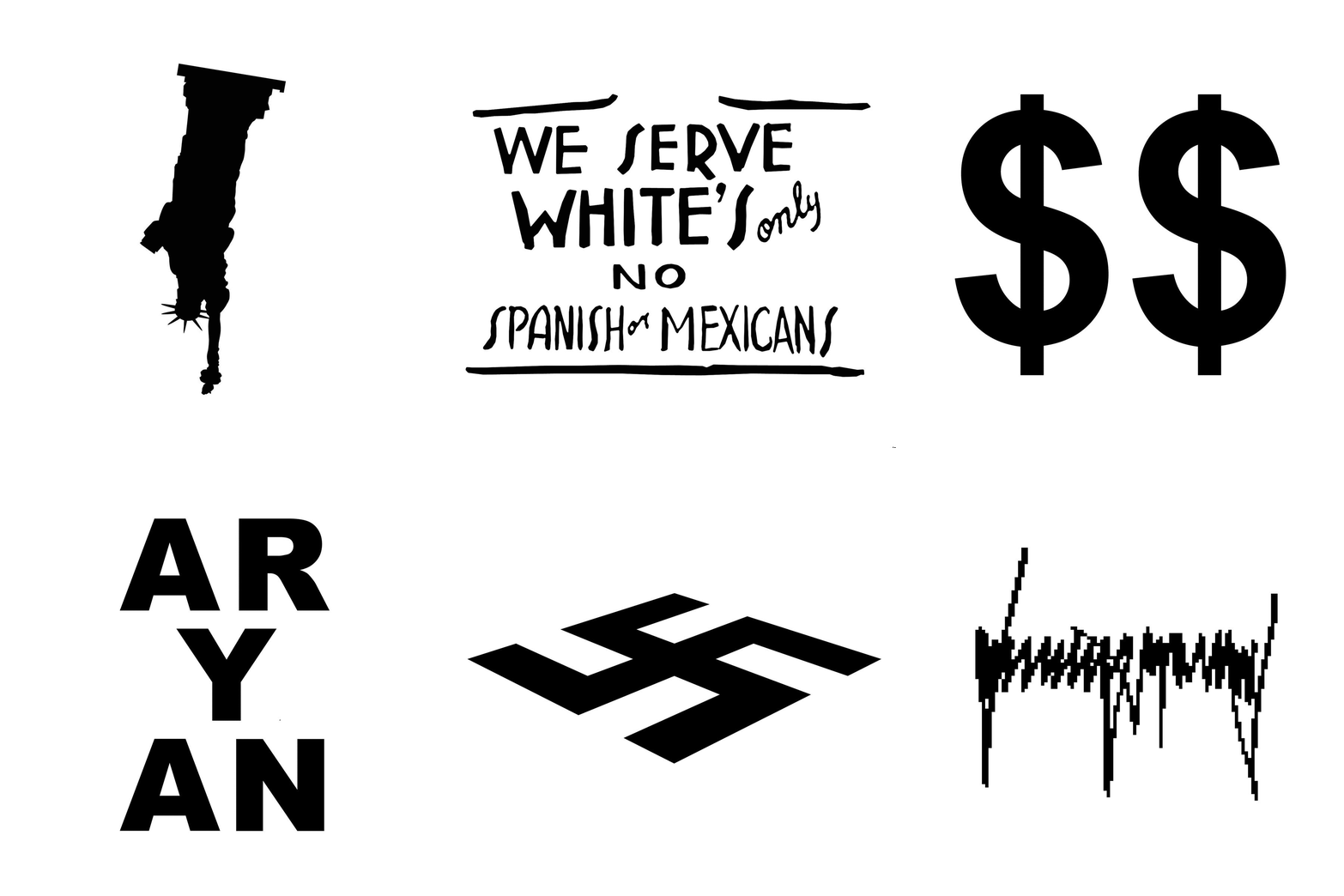
the merchant prince (el príncipe marchante) retrata el ocaso del imperio con el que crecimos. O sea, el fin de lo que conocimos como el sueño americano. La fórmula de un desastre devenido del nepotismo, el privilegio-blanco, el panem et circenses y la eventual pérdida de la generación que derrocó al fascismo a mediados del siglo pasado (la memoria de los abuelos). Propiciado por la contaminación del intelecto colectivo y las reaparición de los nacionalismos corporativos de ultra-derecha, aparece la figura mesiánica del principe marchante; que con alimañas demagógicas, hace de la democracia un círculo vicioso propulsado por su vanidad.
Comenzando con la aplicación de símbolos supremacistas, construyo un caos que ilustra las intenciones que destrozan la idea liberal, sometiendo la imagen a una suerte de licuadora visual sin saber qué resultará con la trituración-mezcla de las formas y el contenido. Con elementos de texto en ruso, árabe, castellano y un inglés “de la red”, la característica global del lenguaje permite generar un mapa-mundi en donde la única constante es el cambio. La imagen se “corona” con una silueta de la estatua de la libertad de cabeza, antes un símbolo del renacer migrante global y la esperanza en el nuevo-imperio; hoy, esos principios están en jaque.
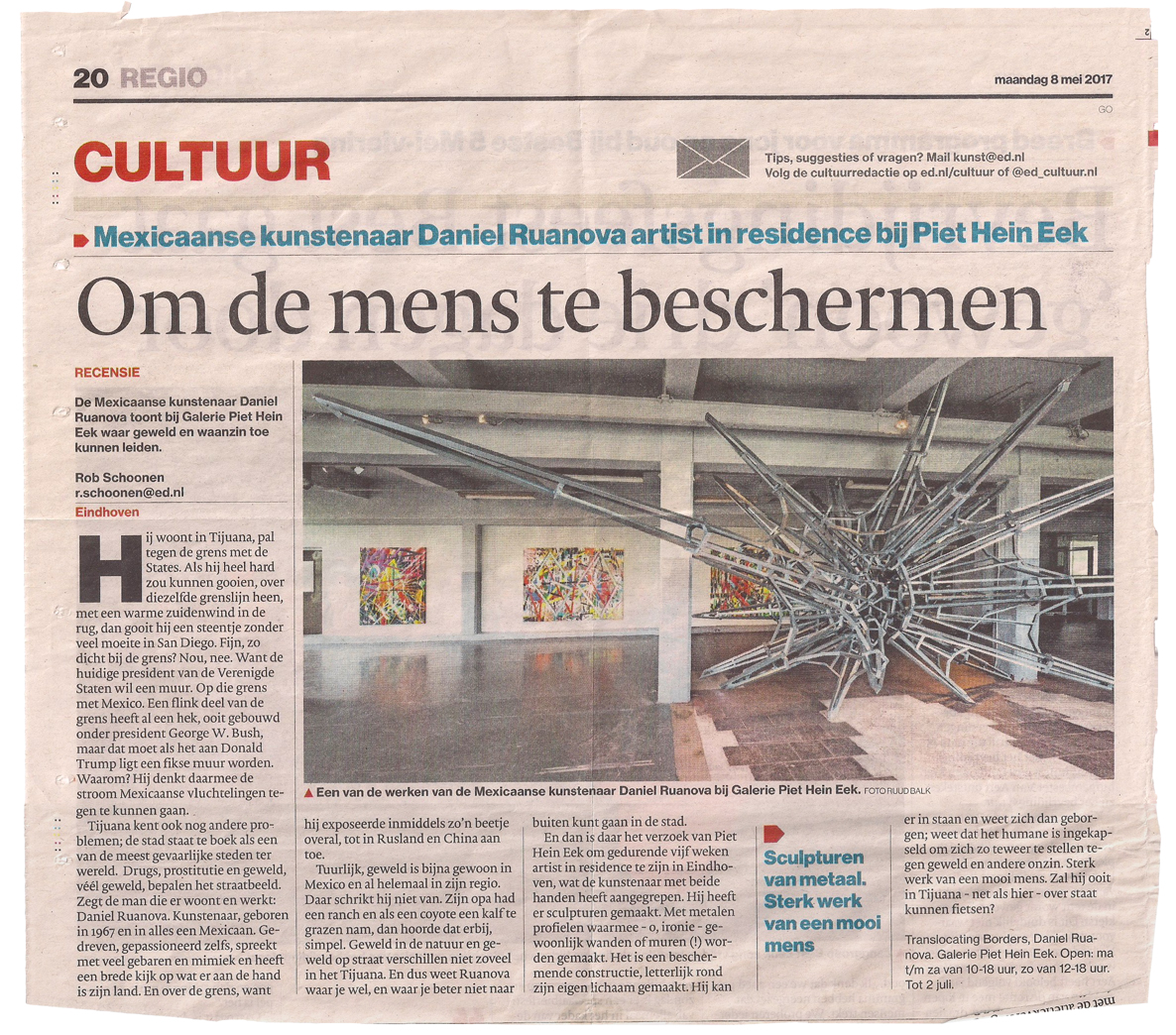
The Mexican artist Daniel Ruanova (1976) comes from a different world and a different culture, a world with urgency and where survival takes time. Death is an integral part of his culture, not only because of the drugs wars, political instability and poverty. As Ruanova himself explains: ‘if you do not embrace death, it will haunt you’. Death and life are inextricably linked with each other and are a part of nature. When a coyote grabbed and ate a calf on his grandfather’s ranch, the very same place in the desert landscape was marked the following year by flowers that had started growing there.
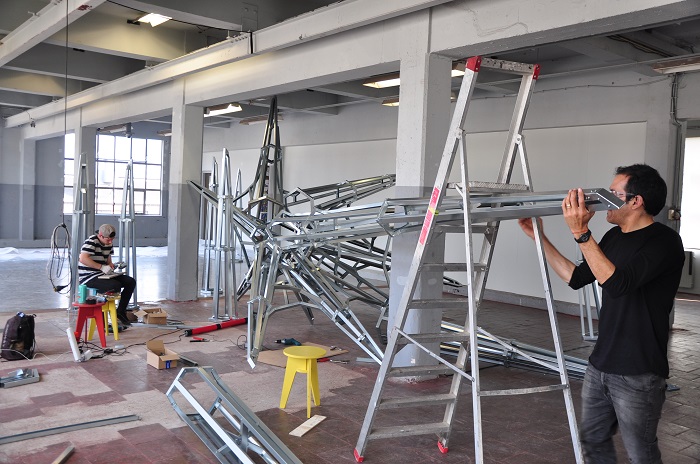
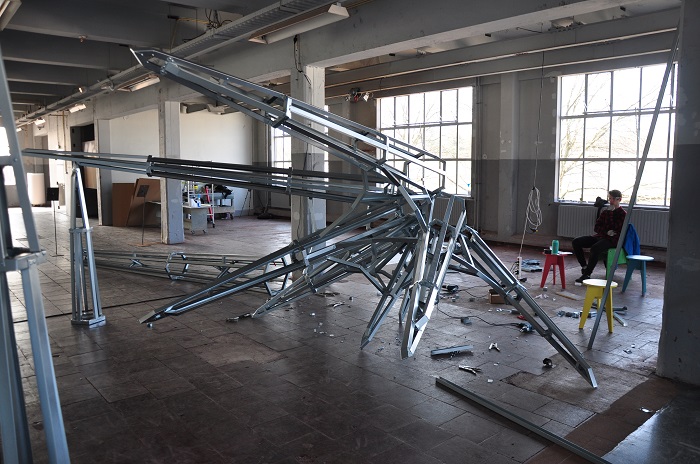
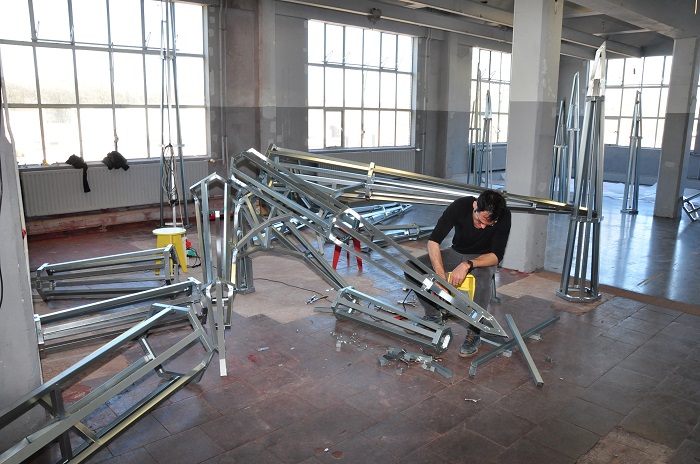
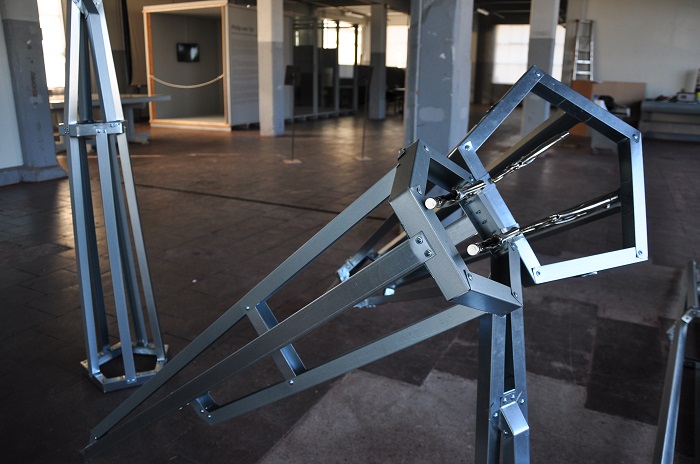
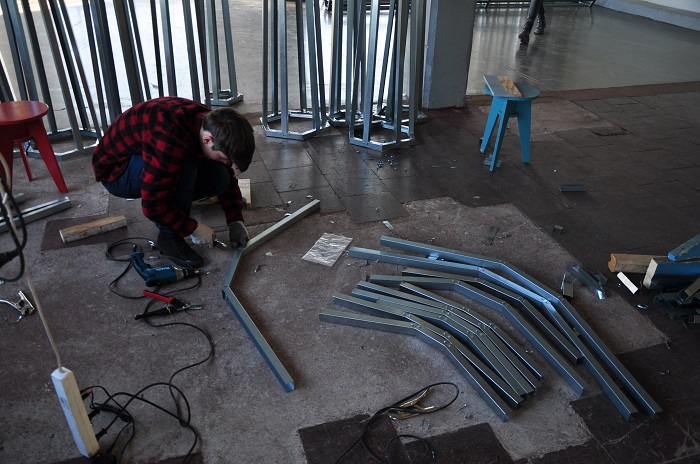
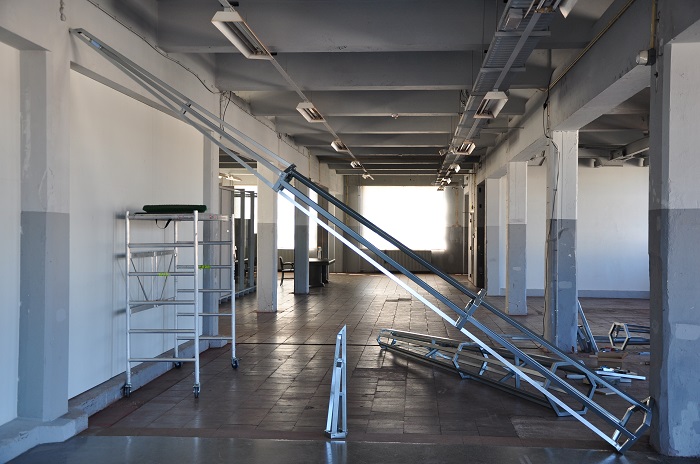
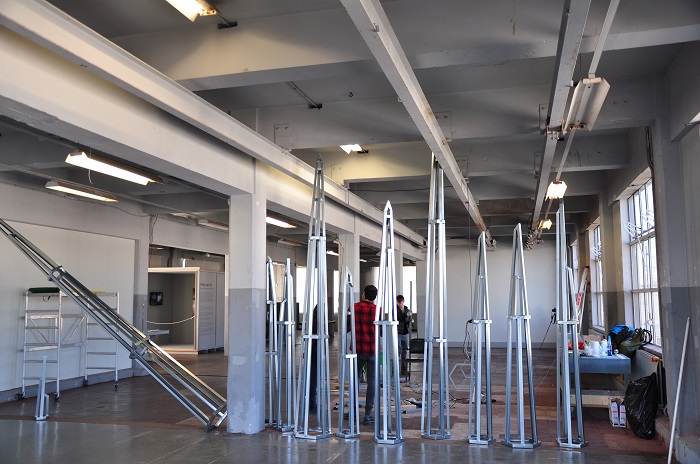
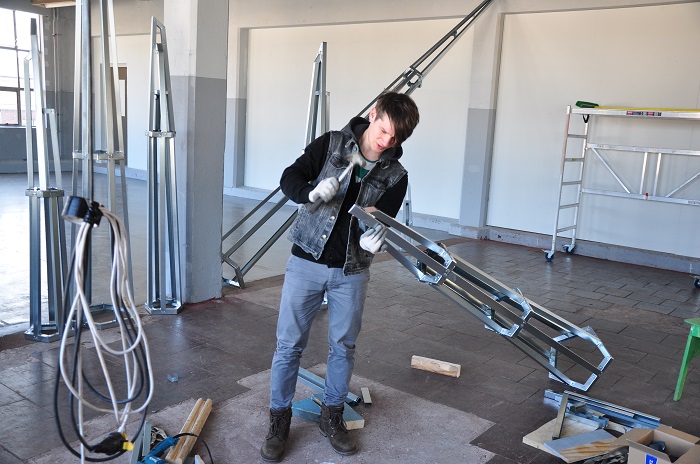
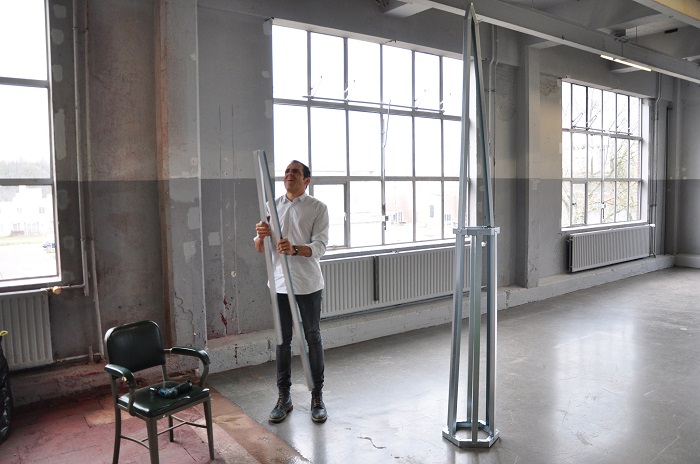
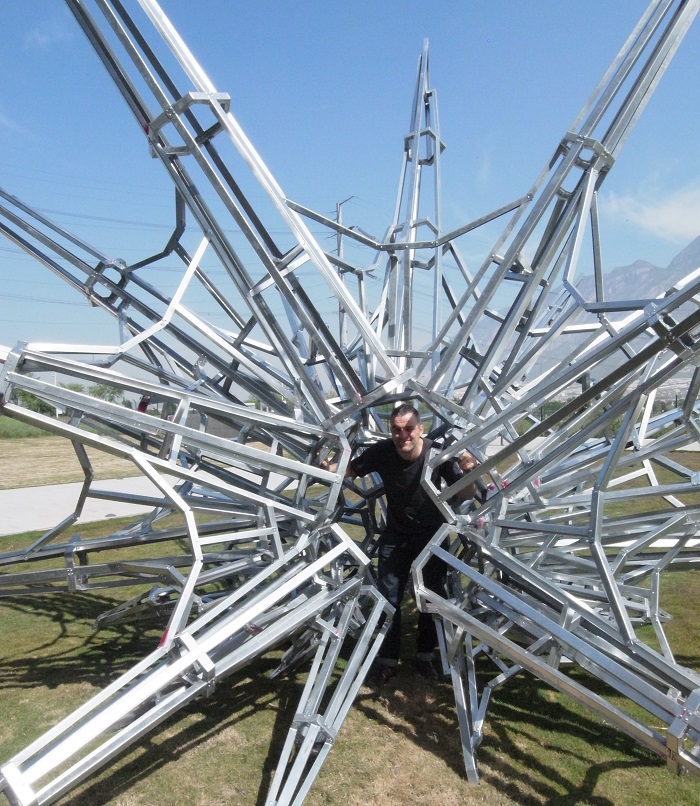
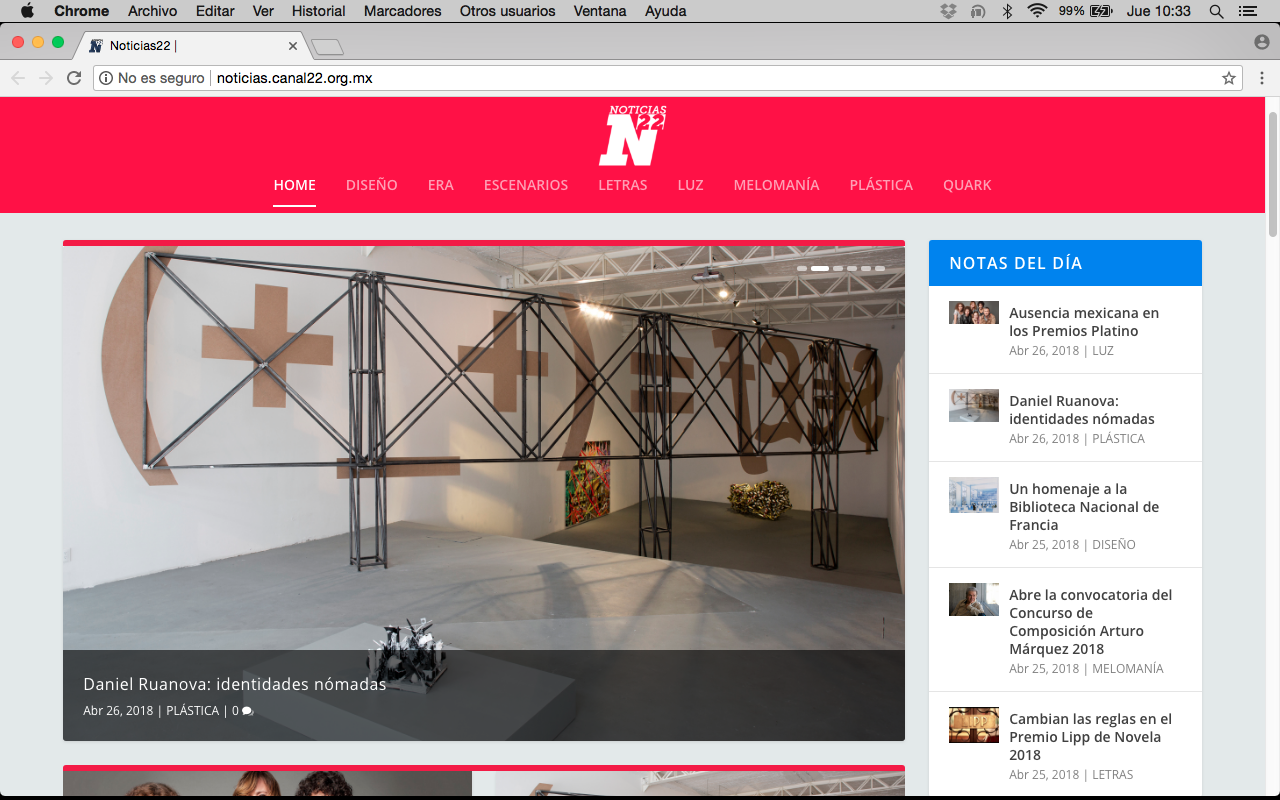
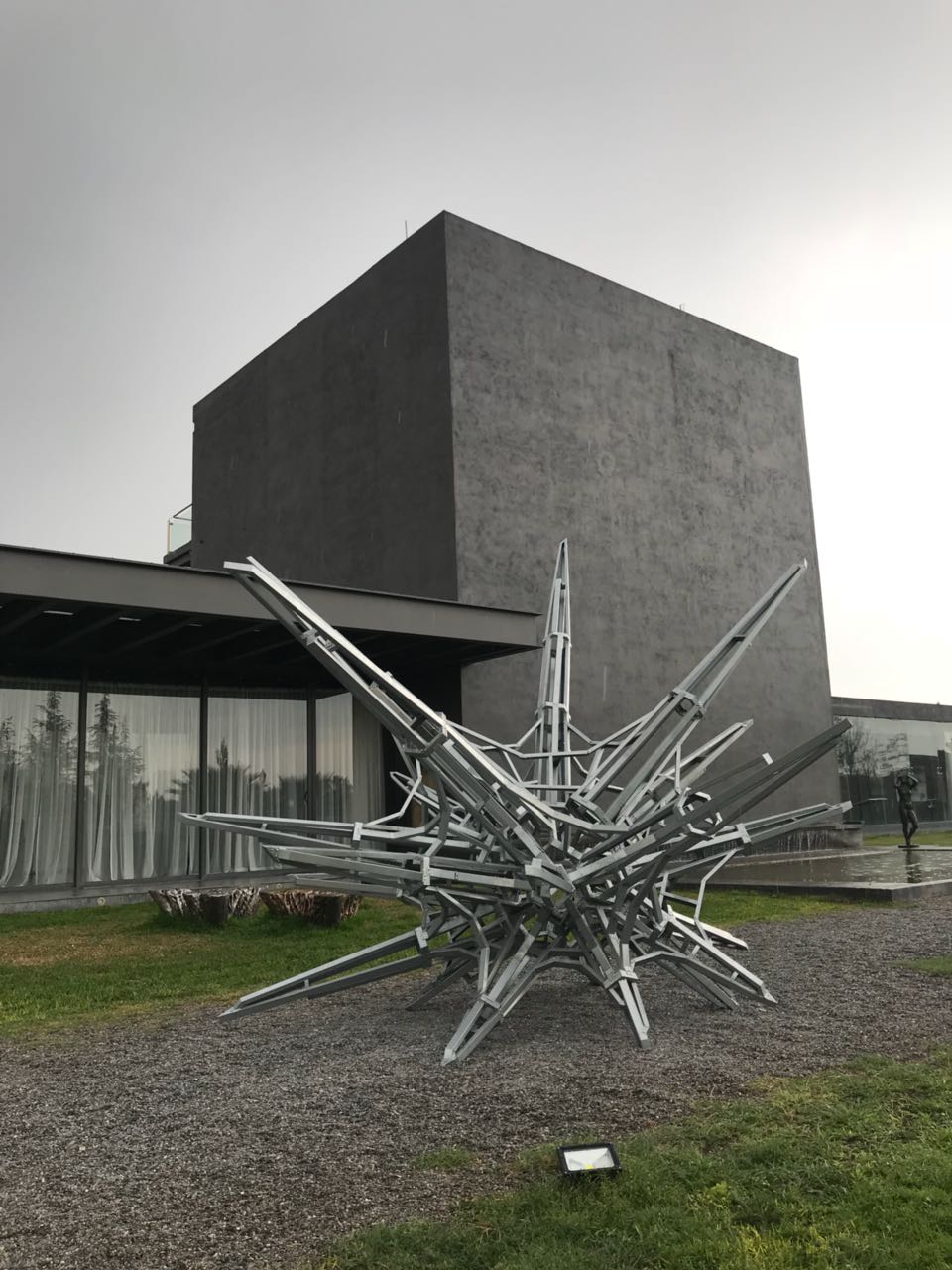
Nature is also a source of inspiration for the defensive constructions that Ruanova makes. The structures, made from modular wall profiles, are created according to the mathematical logics of nature. We now produce these U-profiles ourselves, because the profiles used in Europe proved to be unsuitable. The way in which this structure is built up organically is the same as how a cactus grows and occupies space.
Ruanova has gathered an incredible wealth of knowledge and has developed a feel for the possibilities of using steel construction materials to let a structure grow organically. The structure protects the essence, but is simultaneously also sharply daunting.
According to Ruanova, the art world is changing and he, as an artist, can therefore change this world: his existence as an artist is urgent. Just like a cactus in the desert, he is a part of Mexico – a child of his country – and in everything he does, he breathes and communicates the care, love and unwavering trust in his origins and the future.
He currently lives in Tijuana, a city on the border between Mexico and the United States. Violence and social tension are quite commonplace here. In recent years Ruanova has used his new project ‘New World Border’ to focus on the generation of an increased awareness of border cultures.
The current anti-Mexican political climate in the United States also has a positive side, according to Ruanova. It has led to the fortification of the Mexican culture and a growing self-awareness, which in turn has created new opportunities. As there is growing tension along borders all over the world, and Ruanova’s work transcends local issues due to its contemplative and elaborate nature, his presence with us here in Eindhoven is even more interesting than we thought.
As well as the fact that his work, down to the finest detail, is a result of the consciousness of current affairs and what’s going on in the world, Ruanova also turns out to be an anecdotal narrator and someone who accurately observes his surroundings. Although his sculptures and paintings radiate enormous aggression and give the viewer the impression that he actually wants to shut himself away from the world around him, he actually wants to achieve exactly the opposite. Ruanova is anything but pessimistic. He defines himself as a ‘realist and humanist’, someone who comes from a relatively young culture, in which the future is still open and to which he, as an artist, can have an active contribution.
//
De Mexicaanse kunstenaar Daniel Ruanova (1976) komt uit een andere wereld en een andere cultuur, een wereld met urgentie en waar overleven tijd vergt. Niet alleen vanwege de drugsoorlogen, politieke instabiliteit en armoede, is de dood vast onderdeel van de cultuur. Zoals Ruanova zelf vertelde: ‘als je de dood niet omarmt wordt je erdoor achtervolgd’. Dood en leven zijn onlosmakelijk met elkaar verbonden en zijn onderdeel van de natuur. Als een coyote op de ranch van zijn opa een kalf te grazen nam en opat, werd deze plek in de woestenij het jaar daarop gemarkeerd doordat er bloemen groeiden.
De natuur is tevens de inspiratiebron voor de beschermingsconstructies die Ruanova maakt. De van systeemwandprofielen gemaakte structuren worden volgens de mathematische logica van de natuur vervaardigd. Wij produceren deze U-profielen nu zelf, want de profielen die in Europa worden gebruikt bleken niet geschikt te zijn. De wijze waarop deze structuur organisch wordt opgebouwd is die van hoe een cactus groeit en de ruimte inneemt. Ruanova heeft een ongelooflijke kennis opgebouwd en gevoel ontwikkeld voor de mogelijkheden die er zijn om met de stalen bouwmaterialen een structuur organisch in de ruimte te laten groeien. De structuur beschermt het wezen, maar is tegelijkertijd ook priemend en afschrikwekkend.
Volgens Ruanova verandert kunst de wereld en kan hij als kunstenaar dus de wereld veranderen: zijn bestaan als kunstenaar is urgent. Hij is zoals de cactus in de woestijn onderdeel van Mexico – kind van zijn land – en in alles ademt en communiceert hij de zorg liefde hoop en het rotsvaste vertrouwen in zijn herkomst en de toekomst.
Momenteel is hij woonachtig in Tijuana, een stad op de grens tussen Mexico en de Verenigde Staten. Geweld en sociale spanningen zijn hier aan de orde van de dag. De afgelopen jaren richt Ruanova zich met zijn project ‘New World Border’ op het creëren van een groter bewustzijn bij grensculturen.
De huidige anti-Mexicaanse politiek in de Verenigde Staten heeft volgens Ruanova ook een positief punt. Het leidt tot de versterking van de Mexicaanse cultuur en een groeiend zelfbewustzijn, waardoor ook weer nieuwe kansen worden gecreëerd. Omdat er wereldwijd spanningen langs grenzen zijn en het werk van Ruanova, door de beschouwende en doorwrochte aard ervan, de plaatselijke problematiek overstijgt, is zijn aanwezigheid bij ons in Eindhoven nog belangwekkender dan we dachten.
Naast dat zijn werk tot in de haarvaten voortkomt uit bewustzijn van de actualiteit en waar het in de wereld over gaat, blijkt Ruanova ook een anekdotische verteller en iemand die de wereld rondom hem heen nauwkeurig observeert. Hij is allesbehalve pessimistisch en definieert zichzelf als een ‘realist en humanist’, iemand die uit een relatief jonge cultuur komt, waarin de toekomst nog open ligt en waaraan hij als kunstenaar een actieve bijdrage kan leveren.
_____________________________________________
Information of individual works:
DEFENSE seed I / Galvanized steel drywall studs and self drilling screws / Ø 80 cm / 2017
DEFENSE seed II / Brass drywall studs and self drilling screws / Ø 80 cm / 2017
THE FUCK OFF PROJECT – SAFE AREA 11 / Galvanized steel drywall studs and self drilling screws / 700 x 800 x 400 cm / 2008 – 2017
HplFN – Peace Dove II / Acrylic on canvas (two sides), metal pushpins and aerosol on wood / 140 x 185 cm / 2017
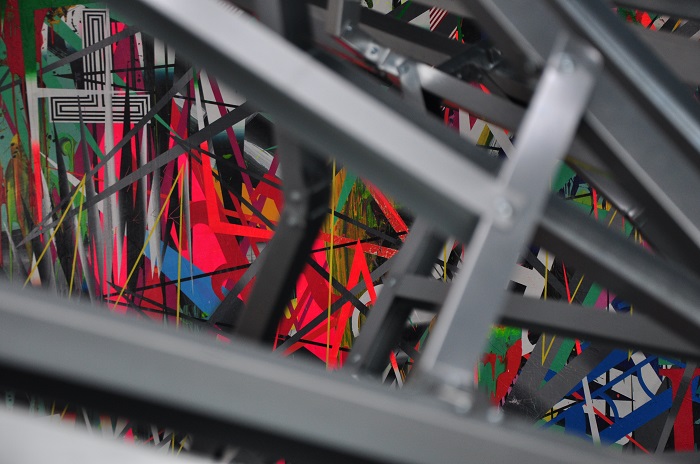
HplFN – MY $€£ƒ / Acrylic on canvas / 153 x 198.5 x 5 cm / 2017
HplFN – GO / Acrylic on canvas / 257 x 198.5 x 4 cm / 2016
HplFN – FUCKIN WALL / Acrylic on canvas / 257 x 198.5 x 4 cm / 2017
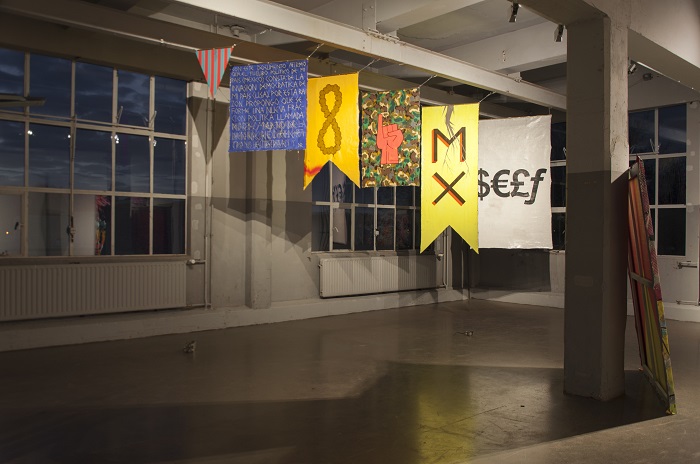
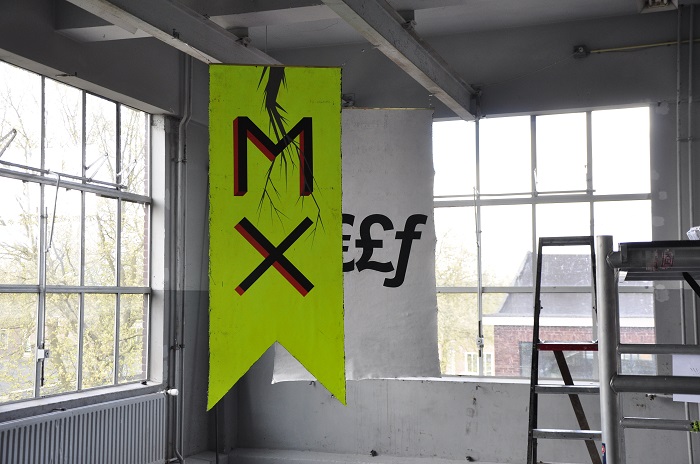
Heraldry for the Complacent – two Sided Battle Standards / Acrylic on canvas (two sides x 6) / variable dimensions aprox. 130 x 200 x 500 cm / 2015 -2017
$€£ƒ / digital print on paper / ed. of 5 / 59.4 x 80 cm / 2017
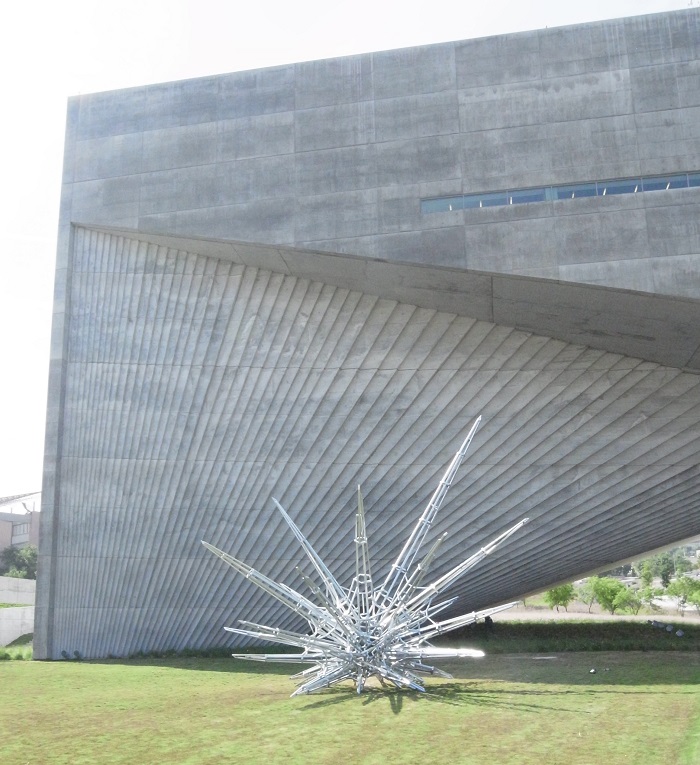
When I paid a flying visit to the University of Architecture in Monterrey, Mexico for a lecture over a year ago, an artwork by the Mexican artist Daniel Ruanova stood outside the entrance to the beautiful building designed by the Japanese architect Tadao Ando. Inside the building, close to the entrance, was more of his work on display in the exhibition space.
It is quite intelligent and modern to display art in the entrance hall of an institute where creativity is the main focus – as is the case with architecture, or rather it should be. This stimulates a dialogue between the mutual influences of the creative professions. This is instead of the increasingly oppressive isolation that is caused by the general belief in specialisation, from which we are now gradually (thankfully) struggling away from.
The work that stood outside, an angular, constructive and open piece of protective clothing, is somewhere between isolation and openness, polarisation and reconciliation, fear and security. As is sometimes the way in the animal kingdom: protect yourself by scaring off others. For us in the Netherlands such issues are much lower on the agenda, or even not at all, but in Mexico there is arbitrariness and fear, and violence is the order of the day.
Daniel is our artist-in-residence and will create a sculpture during his time in the gallery. The creation process will form an important component of the exhibition, and visitors can follow this work-in-progress in the gallery. The opening is on 23 April. We have also had several canvasses shipped over from Mexico that make the exhibition equally as powerful as I experienced it in Monterrey and perhaps even more beautiful, as the making of is now an integral component of the exhibition.
photos from: Piet Hein Eek´s visit to Monterrey, MX
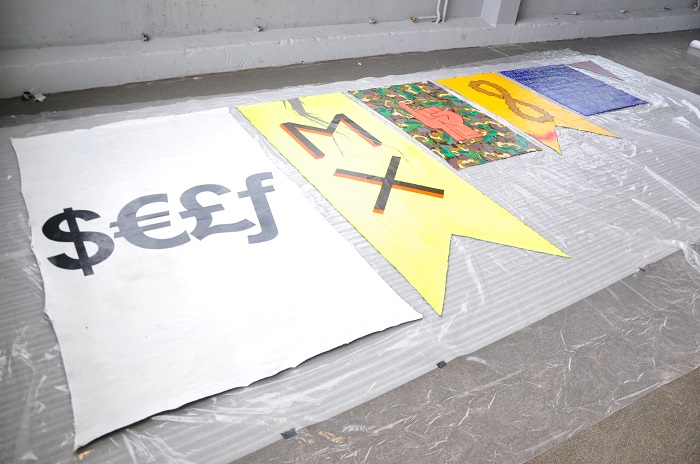
H.f.t.C. / H.p.l.C = Heraldry for the Complacent / Heráldica para los Complacientes
Text translation from blue flag / Traducción del texto de bandera azul:
CON ESTE DOCUMENTO AFIRMO
QUE EL FUTURO POLÌTICO DE MI
PAÍS (MÉXICO), CONSTA DE LA
INVASIÓN DEMOCRÁTICA DE
MI PAÍS (U.S.A.). POR ESTA RA-
ZÓN, PROPONGO QUE SE
FORME UNA NUEVA FRAC-
CIÓN POLÍTICA LLAMADA:
XXXXXXXXXXXXXXXXXX-L-A
XXXXXXXXXXXXXXXXXXXXX
XXXXXXXXXXXXXXXXXX DR
//////////
WITH THIS DOCUMENT I AFFIRM
THAT THE POLITICAL FUTURE OF MY
COUNTRY (MEXICO), CONSISTS IN THE
DEMOCRATIC INVASION OF
MY COUNTRY (U.S.A.). FOR THIS REASON,
I PROPOSE THAT A NEW POLITICAL FACTION
BE FORMED CALLED:
XXXXXXXXXXXXXXXXXX-L-A
XXXXXXXXXXXXXXXXXXXXX
XXXXXXXXXXXXXXXXXX DR
From March 15th to April 25th of 2017, Daniel Ruanova took part in the first ever artist residency project @ PIET HEIN EEK Gallery in Eindhoven, NL. Coming from the borderlands of Tijuana, MX, to the Netherlands for the production of his solo show in the gallery, this is a testimonial interview about his 40 day experience. The edited piece shows the impact that cultural exchange programs have in the lives of its participants and the community they adapt to. The interview was conducted by Pim Hoff, gallery manager @ Piet Hein Eek, and was shot and produced by Anderson Araujo Ferreira (@Andyzeo), two days before the conclusion of the residency.
Les Neosurf casinos permettent de recharger son compte sans divulguer ses informations bancaires. Ce système flexible et accessible dans de nombreux points de vente est une excellente option pour jouer en toute discrétion.

 _____________________________________________